


Subaru’s electric vehicle (EV) push is in full swing, and its latest entry in Australia takes a familiar form but bears an as-yet-unfamiliar name. Enter the Trailseeker.
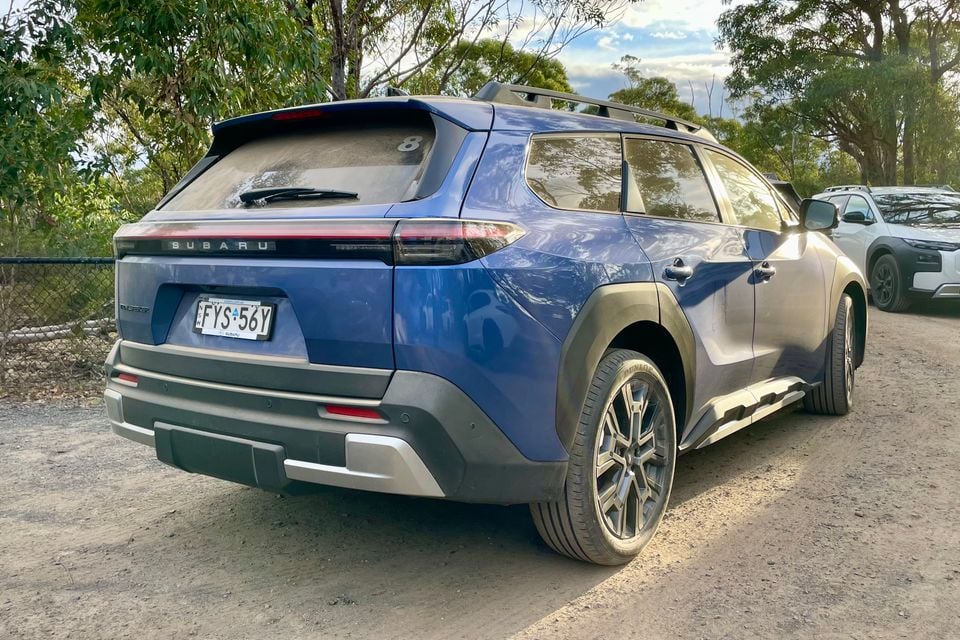
The Japanese auto brand is no stranger to large SUVs that look vaguely like wagons; the Outback has long been one of its most popular nameplates. But even though the Trailseeker is proportionally similar to recent iterations of the Outback, the two have very little in common.
For one, this Subaru is really a Toyota under the skin – as is currently the case for Subaru’s three other global EVs. The donor vehicle here is the Toyota bZ4X Touring, and both are effectively stretched versions of their respective bZ4X and Subaru Solterra mid-size electric SUV twins.
A key point of difference for the Trailseeker is that it’s built by Subaru rather than Toyota, which makes it the first-ever Subaru EV built in-house. Of course, that doesn’t change the Toyota-ness of the finished product.
Further, the Trailseeker is significantly faster than the Outback. With 280kW of power and a claimed 0-100km/h time of 4.5 seconds, Subaru makes no secret of the fact this is its fastest car ever sold in Australia. It’s well up on the 194kW of the current Outback turbo, and even the last WRX STI’s 221kW.

With all that in mind, Subaru Australia made the decision to give the Trailseeker an all-new name to differentiate it from the regular Outback, even if both are claimed to be ‘adventure-ready’. That’s also despite the same model being sold as the e-Outback in markets like Europe.
What does that all mean for potential buyers? Well, the Trailseeker is one of three Subaru EVs that will be on sale locally by the end of 2026, the other two being the existing Solterra and the incoming Uncharted. That will provide more choice when it comes to electrified Subarus than ever before – important given Subaru’s sales are currently down.
It’s also important when it comes to Subaru meeting Australia’s New Vehicle Efficiency Standard (NVES) emissions regulations, as it was one of 19 brands to exceed its fleet-wide CO2 target in 2025. That, however, is entirely dependent on whether buyers flock to these new electric models.
To find out if it’s any good, CarExpert was among the media outlets invited to central NSW to sample the Trailseeker across a wide range of conditions at its national press launch. Is this what Subaru needs to invigorate its EV efforts?
How much does the Subaru Trailseeker cost?
After a price cut in recent weeks, the Trailseeker range starts at $63,990 before on-road costs for the base AWD and extends to $69,990 before on-roads for the flagship Touring.
Model | Price before on-road costs |
|---|---|
2026 Subaru Trailseeker AWD | $63,990 |
2026 Subaru Trailseeker AWD Touring | $69,990 |
Those with a keen eye will notice the Trailseeker’s base price is just $2000 more than that of the Solterra, which itself is $2000 more than the smaller Uncharted. That’s fairly logical given the cars are all very similar to one another, even if their body styles differ.
Find your perfect new car with CarExpert
Direct rivals for the Trailseeker are limited, given its wagon-like SUV stature. The most obvious is its bZ4X Touring twin, which is sold in one variant here priced at $69,990 before on-roads – the same as the Trailseeker Touring.
Buyers may also cross-shop the Zeekr 7X (from $57,900 before on-roads) and the Kia EV6 (from $72,660 before on-roads), even if neither electric SUV is pitched as particularly adventurous. A consistent price benchmark for electric SUVs is also the top-selling Tesla Model Y, priced from $58,900 before on-roads.
A useful in-house comparison can also be drawn with the Subaru Outback, which starts at $48,990 before on-roads for the base AWD and extends to $62,690 before on-roads for the flagship Wilderness Apex.
To see how the Subaru Trailseeker stacks up against the competition, use our comparison tool
What is the Subaru Trailseeker like on the inside?
Fundamentally identical to the Solterra, but that’s no bad thing given the overhaul that model received for 2026.
The similarities are also to be expected when you consider the Trailseeker’s real drawcards come once you move backwards from the B-pillars. For occupants in the front, though, Subaru has created a comfortable space.
The unconventional interior shapes and design elements make this look and feel like a premium cabin, and the functions you’ll use most often are equally high-quality. That centre console, for instance, is practical and fits nicely into the overall interior theme.
It’s finished in what appears to be a relatively durable plastic, which gives off a dull sheen that makes it look a little more upmarket. You get two wireless phone chargers here – which are effective and don’t melt your phone – along with a smattering of driving-related buttons and the gear selector.
This rotating unit is taken straight from the Toyota parts bin and, while it’s sturdy, it isn’t the most intuitive for newcomers. We don’t love that the ‘Park’ button has been isolated either, nor the fact it’s finished in smudgable, scratchable piano-black plastic.
Much like the Solterra, the Trailseeker also lacks a passenger-side glovebox. This is a disappointing storage limitation, and means you’ll have to rely on either the not-so-private tray under the centre console or the modestly sized central storage box for all your loose items.
At least you can open the box’s lid sideways to face either the passenger or driver for ease of access, and there are two USB-C ports and a 12V in that central tray. The console is capped by two low-sitting cupholders, which are positioned nicely for taller bottles.
The Trailseeker’s interior touchpoints in this area are a highlight. The armrests are plenty soft, and everything you need to press or move responds with a confident, robust feel.
That extends to the seats and driving controls. The seats are finished in black synthetic leather or black-and-blue ‘leather-accented’ upholstery, depending on the variant, but they’re consistently comfortable and supportive.
Front seat heating is standard, while ventilation is added with the top-spec Touring. Regardless, they’re good for long drives and even offer subtle side bolstering for harder cornering. Power adjustment is also standard, something you’re almost certain to make good use of.
The driving position has the same flaws as the Solterra. The high-mounted instrument panel disrupts the dashboard’s horizon and forces you to look at it over the steering wheel, not through it. This is awkward compared to more traditional cars, hence the need to fiddle with the seat and tiller position.
Subaru has at least carried over its squared-off steering wheel to help with this issue, which I prefer to the standard round wheel fitted to Toyota’s version of the car. It’s still not perfect, but it could be worse.
The wheel’s diameter is also small, and whether you like that will vary from person to person. It has no shortage of buttons, which is good, even if it’s all a bit cluttered.
Beyond all that, the Trailseeker cabin’s most obvious Toyota part is the 14.0-inch touchscreen infotainment system. Again, it’s identical to the unit fitted to the other Toyota/Subaru EVs, and even some Lexus models.
That’s a big plus – if it’s good enough for Lexus, it’s a real bonus in a Subaru. It’s even nicer to look at and use than Subaru’s own vertical infotainment systems, which can be cumbersome in models like the WRX and Forester.
It responds to inputs without hesitation, and the settings menus are easy enough to navigate. Wireless Apple CarPlay and Android Auto are standard, and it’s certainly a luxury to pair this unit with the Trailseeker Touring’s punchy Harman Kardon sound system – the non-branded alternative is a bit weak.
Our only real complaint here is the climate system is mostly digital. The touch controls are at least large and clearly labelled, supported by two large digitised dials on either side, which are unfortunately a little mushy when they spin.
Okay, I said the Trailseeker starts to show its worth beyond the B-pillars, but that isn’t strictly true. Because it rides on the same 2850mm wheelbase as the Solterra, its second-row dimensions are nearly identical to those of its smaller sibling – but the Trailseeker is marginally taller overall.
Mind you, that isn’t a bad thing. The Solterra is already very spacious in the back, with legroom being no issue whatsoever. The panoramic glass roof of the Touring may eat into headroom for taller passengers but, at 173cm, I had no problems fitting inside.
The floor is also completely flat, thanks to the car’s dedicated EV platform, which makes it easy to scoot across if need be. The bench seat’s slippery upholstery and conservative sculpting could mean more side-to-side movement than occupants might like during cornering.
Still, it’s comfortable back there, and the glass roof helps open up the space given the high window line. Standard amenities back here include two rear-facing air vents, two USB-C ports, and seat heating for the outboard positions.
The boot is the real drawcard of the Trailseeker’s interior. It’s positively massive, comparable to – if not better than – even the space offered in the very expansive boot of the Tesla Model Y. The real advantage here is length, as the boot floor extends incredibly far into the cabin, with accessibility aided by a hands-free power tailgate.
That said, it is incredibly disappointing there’s no spare wheel here. We know tyre repair kits are pretty much the norm for EVs, but come on – how can a vehicle be pitched with adventure-ready soft-roading capability without a spare?
Adding insult to injury is the fact there’s almost a spare-wheel-sized cutout under the boot floor. Surely some more thought to the plastics and trim here could’ve made a space-saver fit, even with the rear electric motor underneath. Toyota’s fault or not, this is a huge letdown.
We can at least appreciate the vehicle-to-load (V2L) capability granted by the power outlet in the driver’s side of the boot. This is only available in the top-spec Touring, but it’s nice to have nonetheless.
Dimensions | Subaru Trailseeker |
|---|---|
Length | 4845mm |
Width | 1860mm |
Height | 1675mm |
Wheelbase | 2850mm |
Cargo capacity | 609L (rear seats up, Trailseeker AWD) |
To see how the Subaru Trailseeker stacks up against the competition, use our comparison tool
What’s under the bonnet?
Powering the Trailseeker is a dual-motor all-wheel drive setup with up to 280kW of power, though there’s no official combined torque figure. Energy comes from a 74.7kWh lithium-ion battery sourced from Chinese manufacturer CATL.
Specifications | Subaru Trailseeker |
|---|---|
Drivetrain | Dual-motor electric |
Battery | 74.7kWh li-ion |
Peak power | 280kW |
Peak torque | 268Nm + 268Nm |
Drive type | All-wheel drive |
Tare mass | 2040kg (Trailseeker AWD) |
0-100km/h (claimed) | 4.5 seconds |
Energy consumption (claimed) | 15.4kWh/100km (Trailseeker AWD) |
Claimed range (WLTP) | 533km (Trailseeker AWD) |
Max AC charge rate | 22kW |
Max DC charge rate | 150kW (30min 10-80 per cent) |
We didn’t get enough time in any one Trailseeker vehicle on Subaru’s media launch to record a representative real-world energy consumption figure.
To see how the Subaru Trailseeker stacks up against the competition, use our comparison tool
How does the Subaru Trailseeker drive?
Fastest Australian-delivered Subaru ever? Oh yes, without a shadow of a doubt.
The Trailseeker is a monster of straight-line acceleration, regardless of the trim level. Even without any dedicated launch control or anything else to help you get off the line, planting the throttle will have it shooting off like a startled rat.
Its all-wheel drive configuration means it has no problem getting all 280kW to the ground either. Now, we can’t ignore the fact that other EVs like the BYD Sealion 7 and Tesla Model Y produce considerably more power – up to 390kW and 461kW, respectively – but there’s a different vibe to the Trailseeker’s character.
It’s quick, but not scarily so. The unassuming motorist won’t even find all that power unless they press the throttle more than halfway, which is all you realistically need if you’re going for an overtake or shooting up to freeway speeds.
Despite its size, the Trailseeker also feels particularly well-balanced. The chassis seems like it can handle the huge power output and more, which you can’t say about many other smaller, outrageously powerful electrified SUVs.
Furthermore, the Trailseeker is equipped with the right technology to make that power manageable for all drivers. We’ve already mentioned Subaru’s characteristic all-wheel drive configuration, though tyre slip is still possible.
To get around that, a function called ‘Active Cornering Assist’ allows the Trailseeker to brake its inside wheels if it detects understeer while turning. This directs power and torque to the outer wheels to promote rotation and stability, helping keep you from ploughing straight on into a barrier.
The result isn’t too dissimilar to what you get with well-calibrated active torque-vectoring systems, and it makes the Trailseeker feel slightly more planted, more predictable, and more confidence-inspiring. It’s not a Subaru-specific feature, but it’s something that you can certainly feel on the road.
Combine that with a passive suspension damping tune that errs on the firmer side, and you have an EV that’s a relatively enjoyable steer. We also like the impression of nimbleness created by the small-diameter ‘squircle’ steering wheel, which is backed by solid weighting.
From expert reviews to the right deal
CarExpert brings together reviews, research tools and trusted buying support, guiding you from research to delivery with confidence.
Of course, the Trailseeker is a big beast, and a heavy one at that. Two tonnes is nothing to sneeze at, nor is the vehicle’s nearly five-metre length – so Toyota and Subaru have done a good job to avoid making it feel bloated.
Rapid acceleration naturally helps with that, but the big thing is that the car feels stable and planted at all times. The suspension does well to manage the car’s weight, keeping it from bouncing around too much on rough roads.
The body is also nicely controlled around turns, where roll is managed reasonably well at speed. Mid-corner bumps don’t unsettle the Trailseeker too much, either.
That said, ride quality is where we noticed the largest on-road difference between the base Trailseeker and the flagship Touring. Put simply, we far preferred the base model with its 18-inch wheels, which look a bit dinky on the car but wear chunky tyre sidewalls offering noticeably more cushioning.
Harsh bumps are better mitigated by this wheel/tyre combo, resulting in far fewer jolts inside the cabin. With the Touring’s 20-inch alloys and thinner rubber, the ride has a sharper, more uncomfortable edge.
The same can be said about road noise and overall refinement. The Trailseeker is well-muffled as a baseline, but it’s impressively quiet and smooth on the smaller alloys – considerably less so on the subjectively cooler-looking 20s.
But arguably the biggest benefit is driving range. Subaru claims the base Trailseeker can travel nearly 50km further than its more expensive sibling on a single charge, which is a lot given this SUV’s range capabilities are hardly class-leading anyway.
We’ll have to wait for a Trailseeker to come through the CarExpert garage to see how that translates in the real world, but it’s certainly useful context on paper.
Beyond that, there are a couple of toys to play with when you’re on the move. You get three drive modes – Normal, Eco, and Sport – that all do what they say on the tin. Eco is more docile and more efficient, while Sport sharpens throttle response and weights up the steering.
It all feels fairly natural, as does the regenerative braking function. There’s a range of different regen strengths to flick through using the steering wheel paddles, though even the most aggressive setting stops short of true one-pedal driving.
Still, we like being able to flick between modes on the fly, and it’s particularly helpful when maintaining speed downhill. We can also commend the physical brake pedal for feeling very natural, which isn’t always the case in cars that combine regen and friction braking.
The Trailseeker’s safety tech all works as intended, with things like front and rear parking sensors and a surround-view camera fitted as standard. The only gripe we had was with the driver attention monitor, which was a touch too sensitive – an unfortunate trend in newer Toyotas and Subarus.
But how does the Trailseeker go when it’s time to seek a trail? Fairly well, at least as well as a large electric SUV can. Subaru SUVs have long been known for their decent ground clearance, and the Trailseeker’s 211mm is only slightly down on the regular Outback’s 220mm.
That gives you just enough clearance to tackle largish dips, bumps, and rocks of the kind you may find on an average gravel road on the way to a campsite or picnic area. You can fiddle with the two X-Mode off-road modes to optimise torque delivery and traction control as needed.
Again, it’s a real shame there’s no spare wheel for such conditions. You probably won’t want to be soft-roading with the 20-inch wheels anyway, as that extra cushioning from the 18s makes the base model a lot more comfortable on rough unsealed surfaces.
All in all, the Trailseeker offers a very polished driving experience. It may not be outstanding in any one metric, aside from maybe off-road ability compared to other EVs, but it’s a culmination of well-considered engineering and tech decisions that result in strong performance across the board.
To see how the Subaru Trailseeker stacks up against the competition, use our comparison tool
What do you get?
The Subaru Trailseeker is available in two variants.
2026 Subaru Trailseeker AWD equipment highlights:
- 18-inch alloy wheels
- Tyre repair kit
- Auto LED headlights
- Rain-sensing wipers
- Power-folding heated side mirrors
- Digital rear-view mirror
- Steering wheel regeneration paddles
- Leather-wrapped steering wheel
- Heated steering wheel
- Black synthetic leather upholstery
- 8-way power-adjustable front seats
- Driver’s seat lumbar support
- Heated front seats
- Heated rear outboard seats
- 7-inch digital instrument display
- 14-inch touchscreen infotainment system
- Wireless Apple CarPlay and Android Auto
- Satellite navigation
- Bluetooth
- DAB+ digital radio
- 6-speaker sound system
- 2 x front USB-C ports
- 2 x rear USB-C ports
- Dual wireless phone chargers
- Multi-colour interior ambient lighting
- Dual-zone climate control
- Hands-free power tailgate
- 3 drive modes:
- Dual-mode X-Mode:
Trailseeker AWD Touring adds:
- 20-inch alloy wheels
- Optional two-tone paint
- Auto-dimming side mirrors with position memory
- Black and blue leather-accented upholstery
- 2-position driver’s seat memory
- Ventilated front seats
- 10-speaker Harman Kardon sound system
- Panoramic glass roof
- 220V/1500W vehicle-to-load outlet
To see how the Subaru Trailseeker stacks up against the competition, use our comparison tool
Is the Subaru Trailseeker safe?
The Subaru Trailseeker has a five-star ANCAP safety rating, based on Euro NCAP testing of the European e-Outback and Toyota bZ4X in 2025.
Category | Subaru Trailseeker |
|---|---|
Adult occupant protection | 89 per cent |
Child occupant protection | 86 per cent |
Vulnerable road user protection | 80 per cent |
Safety assist | 82 per cent |
Standard safety equipment highlights:
- 8 airbags, incl:
- Front
- Front-side
- Front centre
- Curtain
- Driver’s knee
- Adaptive cruise control
- Blind-spot monitoring
- Driver attention monitoring
- Emergency Driving Stop System (EDSS)
- Front and rear parking sensors
- Lane-centring
- Lane-keep assist
- Multi-terrain monitor
- Rear cross-traffic alert
- Safe exit assist
- Surround-view monitor
- Traffic sign recognition
- Tyre pressure monitoring
The Trailseeker AWD Touring adds advanced park assist.
To see how the Subaru Trailseeker stacks up against the competition, use our comparison tool
How much does the Subaru Trailseeker cost to run?
Subaru Australia backs its range with a five-year, unlimited-kilometre warranty, and its EV batteries with an eight-year, 160,000km warranty. Servicing for the Trailseeker is required every 12 months or 15,000km, whichever comes first.
Servicing and Warranty | Subaru Trailseeker |
|---|---|
Vehicle warranty | 5 years, unlimited kilometres |
High-voltage battery warranty | 8 years, 160,000km |
Roadside assistance | 12 months |
Service intervals | 12 months or 15,000km |
Capped-price servicing | 5 years |
Average annual service cost | $196.84 |
Total capped-price service cost | $984.18 |
Subaru Australia’s individual service pricing is detailed below:
Service | Price |
|---|---|
12 months, 15,000km | $128.87 |
24 months, 30,000km | $290.55 |
36 months, 45,000km | $128.87 |
48 months, 60,000km | $300.85 |
60 months, 75,000km | $135.04 |
Service costs are practically identical to those of the Solterra, which are only slightly more than what Toyota charges for the bZ4X. Toyota has yet to outline its service pricing for the bZ4X Touring.
Rivals like the Zeekr 7X are more expensive to service over five years, with costs totalling $2385, while a service package for the same duration with the Kia EV6 costs at least $1391.
As for the petrol Outback, both naturally aspirated and turbocharged models cost roughly $2350 to service over five years.
To see how the Subaru Trailseeker stacks up against the competition, use our comparison tool
CarExpert’s Take on the Subaru Trailseeker
Regardless of where it’s built or whose car is underneath, Subaru has produced another solid EV that builds on the strengths introduced by the Solterra earlier this year.
It has the same higher-capacity battery, the same premium-feeling interior, and the same high-grade tech, with no real compromises on ride comfort or light off-road capability.
In fact, the Trailseeker can conceivably be considered the better value option of the two. Both variants are only $2000 more expensive than their smaller Solterra equivalents, yet pack a considerably larger boot and a tad more power – not that the 252kW Solterra is slow.
The only real negative of the Trailseeker is its driving range, because the base model’s 533km claim is down on the base Solterra’s 566km figure. If that doesn’t bother you, the Trailseeker simply offers greater bang for your buck.
The only reason you’d avoid this EV is if you really don’t need something quite so large. The spare wheel issue, unfortunately, applies to both models – though Subaru Australia did promise an aftermarket rear-mounted solution at the Solterra’s original launch, and the Trailseeker stands tall as a standalone model.
Again, boot space is the biggest benefit over the rest of Australia’s electric SUV cohort, and you get that cargo capacity without having to commit to a tall, boxy SUV with three rows of seating.
The Trailseeker somehow looks and feels more like an Outback than the Outback itself, too, regardless of its powertrain. We dare say people who liked the previous-generation Outback may find themselves liking this car, and at least it addresses complaints about the combustion-powered model being slow.
The Trailseeker’s only true downsides are its lack of a spare wheel, its almost-obnoxious driver monitor, and its price. It is objectively an expensive car, which leads us to recommend the base AWD over the top-shelf Touring and even the single-variant bZ4X Touring, despite its lack of premium audio and V2L.
It’s far more comfortable, just as quick, and offers a more convenient driving range for considerably less money than the alternatives. It’s also competitively priced against smaller electric SUVs and even the petrol-powered Outback, while being much cheaper to maintain than all of them.
If Subaru continues this EV trend with the Uncharted and beyond, it could find itself popular with a whole new generation of Aussie car buyers.
CarExpert can save you thousands on a new Subaru Trailseeker. Click here to get a great deal.
Click the images for the full gallery