


Mitsubishi Australia has confirmed its first battery-electric vehicle (EV) in more than a decade will be called the Mitsubishi ASX VR-e.
An early EV pioneer with the electric i-MiEV city hatch sold here from 2010 to 2012, Mitsubishi has since fallen behind key Japanese rivals including Toyota – itself previously criticised for its slow adoption of EVs – in offering battery-powered models in Australian showrooms.
Due in local showrooms in the fourth quarter of 2026, the ASX VR-e will change that. Separate to the Renault Captur-based petrol-powered ASX already sold here, it will be based on the Foxtron Bria, which measures 4315mm long, 1885mm wide and 1535mm tall on a 2800mm wheelbase.
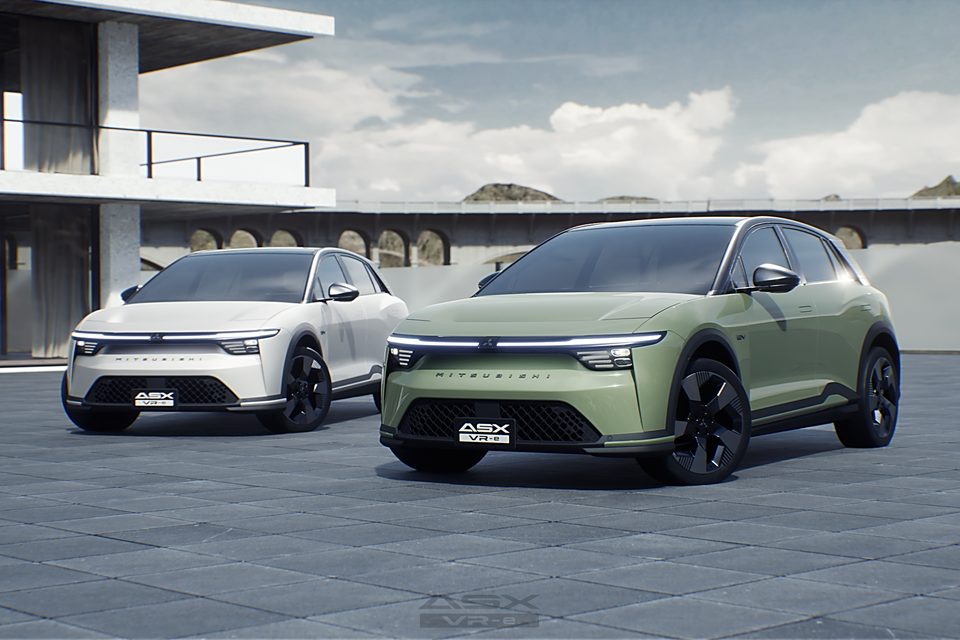
Mitsubishi Australia issued a single image of the exterior, and one image of the interior, while confirming the ASX VR-e will be offered in four model grades: LS, Aspire, Exceed and GSR.
The new EV is being developed through Mitsubishi’s partnership with Taiwan’s Foxtron Vehicle Technologies, a joint venture between electronics giant Foxconn and automaker Yulon.
Mitsubishi says the VR-e name pays homage to the Galant VR-4, the high-performance all-wheel drive sedan introduced in Australia in 1990 and a predecessor to the Lancer Evolution.

It uses a Pininfarina-designed vehicle platform, but Mitsubishi says the ASX VR-e will receive its own front and rear styling, wheels and interior finishes.
The ASX name stands for ‘Active Sports Crossover’, while the VR-e designation references the Galant VR-4.
The Galant VR-4 was powered by Mitsubishi’s 4G63T 2.0-litre turbocharged four-cylinder petrol engine and a full-time four-wheel drive system.
Mitsubishi Australia has yet to announce local pricing, battery capacity, driving range, charging speeds or final powertrain specifications for the ASX VR-e.
In Taiwan, the closely related Foxtron Bria is offered in three model grades – Elegant, Emerge and Pioneer – priced from NT$899,000 (around A$39,470).
That pricing overlaps with the petrol-powered Mitsubishi Eclipse Cross – discontinued in Australia in 2025 – which starts at NT$1,105,000 (around A$48,510) in Taiwan.
The entry-level Bria Elegant and mid-range Emerge use a 171kW rear-mounted electric motor and a 57.7kWh lithium iron phosphate (LFP) battery. Foxtron claims a 0-100km/h time of 6.8 seconds and 516km of NEDC driving range.
The flagship Bria Pioneer adds a second electric motor for all-wheel drive, producing 299kW and cutting the claimed 0-100km/h time to 3.9 seconds. Its NEDC range is 466km from the same 57.7kWh battery.
Foxtron claims DC fast-charging at up to 134kW allows a 10-80 per cent recharge in around 30 minutes.
Mitsubishi has not confirmed whether these powertrains or specifications will carry over unchanged to Australian ASX VR-e models.
Inside, there’s standard black cloth trim, 9.2-inch digital instrument cluster and a 15.6-inch centre touchscreen, as well as wireless smartphone charging.
Higher-spec variants add ventilated front seats, a 360-degree camera, panoramic glass sunroof, and an electric tailgate.
Advanced driver assistance systems (ADAS) include adaptive cruise control, lane-centring assist, and rear cross-traffic alert.
The arrival of the ASX VR-e comes amid record EV sales in Australia, with the Tesla Model Y topping the national sales charts across all fuel types in both May and June 2026.
June delivered an all-time record for Australian new-vehicle sales, while last month was the strongest July on record.
Despite the record market, Mitsubishi’s Australian sales fell 27.4 per cent year-on-year during the first seven months of 2026, when every one of its models posted a decline.
The Japanese brand now sits 10th overall with 27,864 sales to the end of July, behind Tesla on 28,366.
The result comes after Shunichi Kihara became Mitsubishi Motors Australia CEO on January 5, 2026, replacing Shaun Westcott, who resigned in September 2025.