


The GWM Tank 300 off-road SUV lineup has gained a new plug-in hybrid (PHEV) powertrain in China and a new long-wheelbase body style, but the Chinese brand’s new turbo-diesel engine won’t be offered.
The Chinese-market Tank 300 lineup will feature the existing Hi4-T and previously confirmed Hi4-Z PHEV powertrains in a new extended-length body wearing the 300L nameplate, while carryover petrol and diesel engines will be offered in carryover standard-length guise.
The standard-wheelbase Tank 300 remains available in China with petrol power, despite GWM Australia phasing out petrol variants locally.
While the larger Tank 500 will gain a new 170kW/620Nm 3.0-litre turbo-diesel four, due in Australia in September, the Tank 300 will stick with an unchanged 135kW/480Nm 2.4-litre turbo-diesel four.
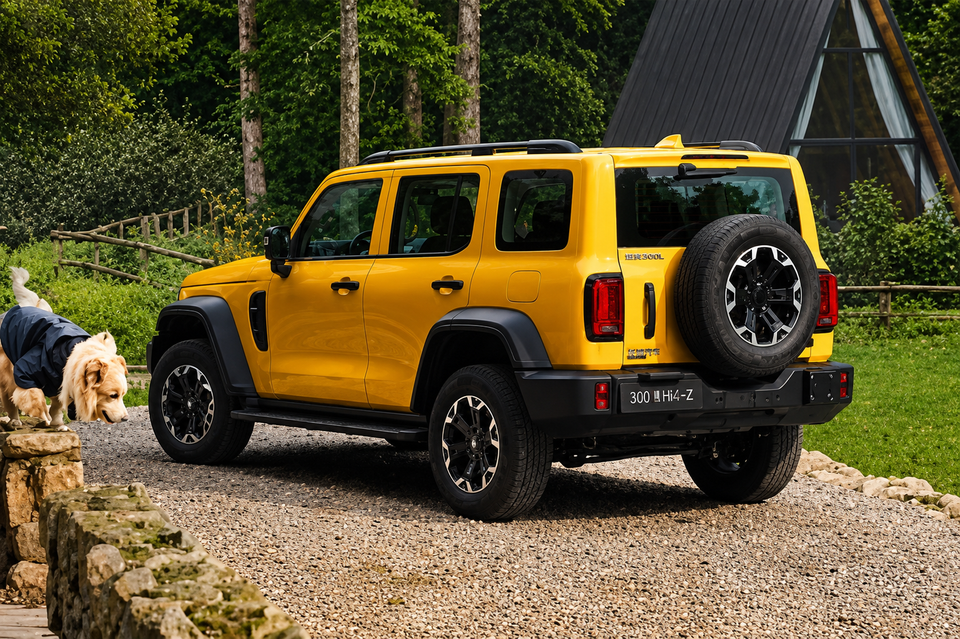
The new Tank 300L PHEVs stretch the regular 300’s 2750mm wheelbase to 3010mm, with overall length increased by 126mm to 4886mm.
The 300L also boasts a 38-degree approach angle and 235mm of ground clearance, up from 224mm in the regular Tank 300.
The stretched model is offered with two PHEV powertrains: the flagship Hi4-Z system, already available overseas in the Tank 500 and Tank 700 (not sold here), and an updated Hi4-T system, a version of which powers the Australian-market Tank 300 PHEV.
GWM Australia has previously told CarExpert it’s exploring the Hi4-Z powertrain for Australia, but has yet to confirm timing or which models it could be offered in locally.

The Chinese-market Tank 300L Hi4-Z combines a 180kW/380Nm 2.0-litre turbocharged four-cylinder petrol engine with a 180kW/400Nm front electric motor and a 200kW/415Nm rear electric motor.
Combined outputs of 560kW and 1195Nm enable a claimed 0-100km/h time of 4.3 seconds, while a 59.6kWh ternary lithium battery delivers up to 200km of electric driving range under the WLTC test cycle.
The Hi4-T offered in the 300L produces a combined 310kW and 750Nm, up from the 300kW and 750Nm delivered by the current Australian Tank 300 PHEV.
It claims a 0-100km/h sprint of 6.1 seconds and up to 105km of WLTC electric driving range from a 37.1kWh battery. Unlike the Hi4-Z, it retains a conventional mechanical four-wheel-drive system with locking front and rear differentials.
That could make the Hi4-T the more suitable option for Australia, as it preserves the existing model’s greater off-road capability, while the Hi4-Z prioritises on-road performance and packaging.
Exterior updates include redesigned front and rear bumpers on Tank 300L variants, plus revised headlights featuring a horizontal strikethrough element, and a new ‘T-A-N-K’ lettered grille.
Inside, compared with the Australian-market Tank 300, there’s a unique dashboard, updated digital instrument cluster, a new steering wheel and centre console, and a column-mounted (instead of console-mounted) gear shifter.
These changes were made to the Chinese-market Tank 300 last year, but new this year on all Tank 300 and Tank 300L variants is a 15.6-inch central touchscreen – up from 14.6 inches in the outgoing Chinese-market model – measuring just 9.5mm thick, which runs the latest Coffee OS 3.0 operating system, adding artificial intelligence (AI)-enhanced voice controls.
Tank 300L variants get the latest Coffee Pilot 3 driver assistance suite, powered in part by a roof-mounted LiDAR unit, which allows for what’s called Navigation on Autopilot (NOA) functionality in both urban and highway driving. Petrol and diesel versions stick with Coffee Pilot 2.0, with highway-only NOA.
The Tank 300 is currently GWM’s fourth-best-selling vehicle in Australia. With 2759 sales to the end of June 2026, the Tank 300 has more than quadrupled the Tank 500’s 629 deliveries in Australia over the same period.