


GWM Australia will further bolster its already burgeoning SUV range with the new Haval Jolion Max, which has now been confirmed for local release in the fourth quarter of this year (October-December) with the option of battery-electric (BEV) and petrol-electric hybrid (HEV) powertrain options.
Speaking with media during an online call, the general manager for marketing and communications at GWM Australia and New Zealand, Steve Maciver, confirmed the “very important” Haval Jolion Max will slot in between the standard Jolion and the H6 mid-size SUV in the Chinese brand’s SUV-only model range.
“The Haval Jolion Max increases the size over the current Jolion, and we’ll offer BEV and hybrid within that particular model as well,” Mr Maciver said.
CarExpert can save you thousands on a new car. Clickhereto get a great deal.
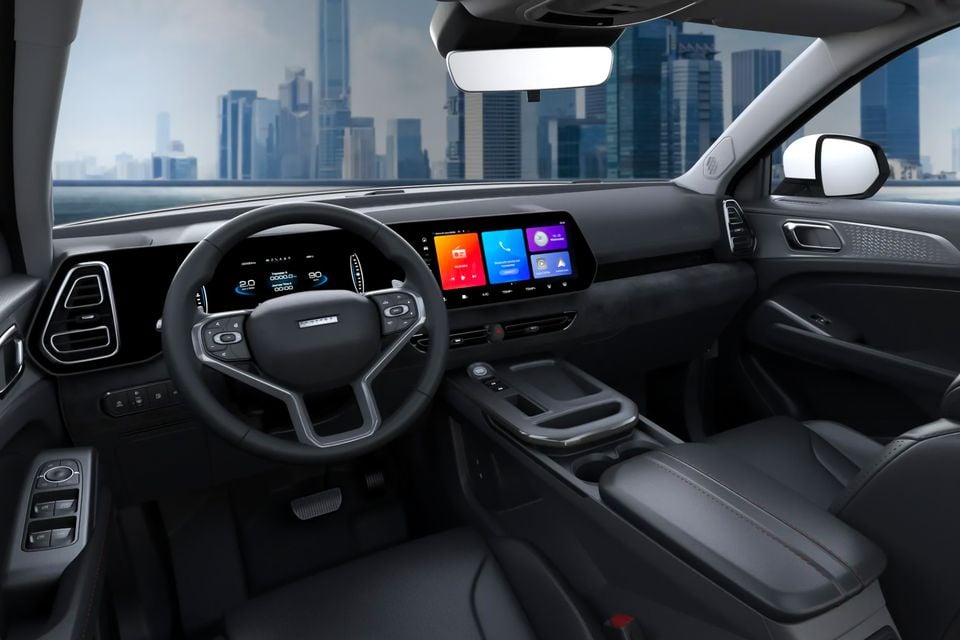

So what is a GWM Haval Holion Max? Official info is hard to find, but the South African market has confirmed a petrol-powered Jolion Max for 2027, which could be indicative of what we could expect from the Australian model.
Measuring 4590mm long and 1877mm wide on a 2710mm wheelbase, the Jolion Max sits between the regular Jolion (4470/1874/2700mm) and the larger H6 (4703/1886/2738mm) in physical size.
The South African market has only confirmed a 130kW/275Nm 1.5-litre turbo-petrol engine similar to the one used in the Australian-spec Jolion Vanta, though Mr Maciver’s comments suggest the 140kW/375Nm 1.5L hybrid system will be either standard or available as an option.
While there’s no current version of the Jolion offered with a battery-electric drivetrain, it’s likely the EV would share its powertrain components with the similarly sized GWM Ora 5 – which has also just been launched in Thailand with the Jolion HEV’s 1.5-litre hybrid system – which means a 150kW/260Nm front electric motor fed by a 58.3kWh lithium iron phosphate battery, good for just over 400km based on the Ora 5’s 430km WLTC figure.
Pricing and specifications will be confirmed closer to launch, but for reference the cheapest petrol-powered Haval Jolion currently starts from a sharp $24,990 drive-away, while the HEV range kicks off from $28,990 drive-away.
Depending on whether a turbo-petrol engine will also be the entry point for the Jolion Max, we could see the small-medium SUV start from under $30,000 drive-away, while the Ora 5’s $33,990 drive-away starting price points to a very sharp low- to mid-$30,000 market position for a Jolion Max EV.
While Haval adds yet another new model to its sprawling local SUV range, the Jolion Max HEV would significantly undercut the cheapest Haval H6 HEV (from $37,990 D/A), while offering a more practical and conventionally styled alternative to the new Ora 5, which itself will relaunch the Ora sub-brand Down Under.
GWM Australia is in the midst of a massive product onslaught in 2026, which includes the aforementioned Ora 5 as well as an updated Haval H6 GT and a Hi4-T PHEV version of the Tank 300, plus all-new 3.0L diesel versions of the larger Tank 500 large SUV and the related Cannon Alpha ute, as well as a Hi4-T PHEV version of the regular Cannon ute, which will be a more budget-friendly alternative to the Cannon Alpha PHEV as well as the BYD Shark 6 and Ford Ranger PHEV.
GWM will also launch its premium Wey sub-brand in the third quarter of 2026, with further details to be confirmed.
The Chinese brand’s product rollout forms part of GWM’s plans to break 60,000 Australian deliveries in 2026, after a record 52,809 units were sold during the 2025 calendar year.
GWM’s local marketing boss also noted that March 2026 was the brand’s best-ever month of sales in Australia with 5680 units, with its ‘New Energy Vehicles’ (ie: HEVs, PHEVs and EVs) accounting for nearly half (46 per cent) of overall sales.
The Jolion line is GWM’s top-selling nameplate locally, with 19,413 examples delivered in 2025 (up 36.3 per cent) and 5606 so far in 2026 (up 34.8 per cent).
Stay tuned to CarExpert for the latest, and tell us your thoughts on the GWM Haval Jolion Max in the comments below.