


Stellantis may be focusing its energy on four core brands, but that doesn’t mean the tap is being turned off for its American brands.
In addition to new products for Jeep and Ram – which, along with Fiat and Peugeot, are considered Stellantis’ four core global brands – the Netherlands-based automotive giant has promised fresh product for Dodge and even oft-forgotten Chrysler.
In all, it plans to increase its coverage of the North American market with these four brands by 50 per cent by 2030, bringing overall market coverage to 90 per cent.
Looking for your next car? We’ll help youresearchandcompareso you choose with confidence.
It also wants to increase sales across these brands from 1.4 million units in North America in 2025 to 1.9 million units in 2030.
It’s all part of a new strategy called FaSTLAne 2030, which will see the automaker spend €60 billion (A$97.6bn) to launch 60 new models, and 50 significant product updates, across all brands globally by 2030.
A total of 70 per cent of its product development budget will go to Jeep, Ram, Peugeot and Fiat, plus the Pro One commercial vehicle unit.
Ram
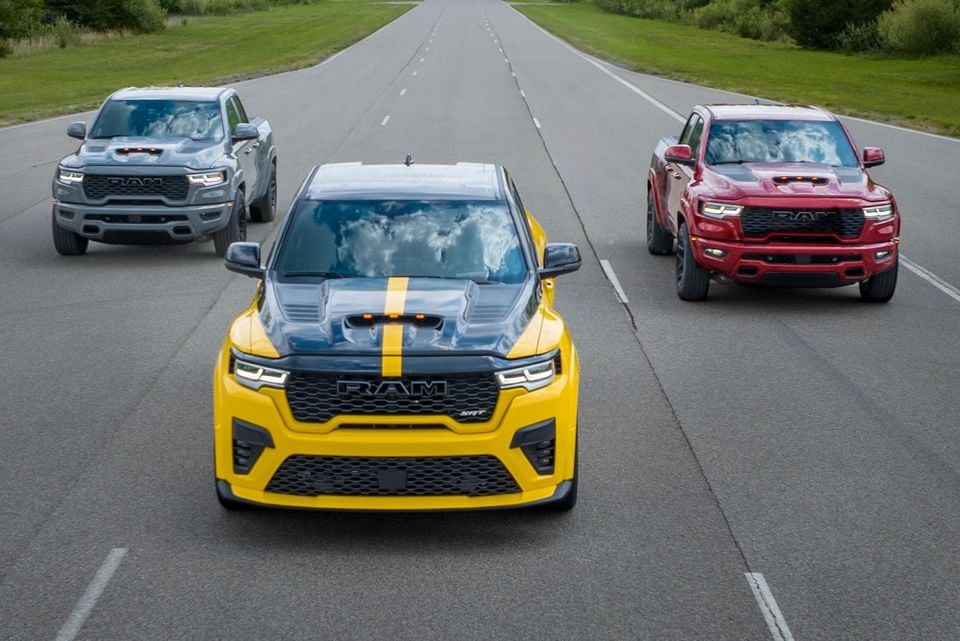
Ram currently sells the 1500, 2500 and 3500 pickup trucks in Australia, which are locally remanufactured in right-hand drive. It announced this week it would reintroduce a supercharged V8-powered 1500, now called the Rumble Bee SRT.

The Ram brand will get its first SUV with the Ramcharger, a name that had previously been reserved for an extended-range electric vehicle (EREV) version of the 1500 which will now be called the 1500 REV.
The name has come full circle, having been used on an SUV version of Dodge’s full-size pickup until 1993 in the US and until 2001 in Mexico.
It’s expected the revived Ramcharger will once again be based on the Ram pickup, which will also make the new model a cousin to the Jeep Grand Wagoneer. A hot SRT version is planned, which will potentially use a supercharged 6.2-litre V8.
It’s unclear if it’ll offer an EREV powertrain like the 1500 REV or the Jeep Grand Wagoneer.
At the other end of Ram’s lineup, the Stellantis brand has confirmed the unibody Rampage dual-cab it developed in Brazil will be sold in North America. It’ll be joined by a larger body-on-frame ute, now confirmed to wear the Dakota nameplate. This is unrelated to the Latin American Dakota launched last year, which is based on the Changan F70.
Ram has confirmed it will launch an SRT version of the new Dakota, which could shape as a Baja-ready rival for the Ford Ranger Raptor sold in markets like Australia and the US. It’s unclear at this stage what engine this will use.
The brand is expecting to grow its sales in North America by 60 per cent to 825,000 units in 2030.
Dodge
Stellantis’ American performance brand has teased what appears to be a slinky two-door coupe with an enormous rear wing.
Some media outlets were invited to a closed-door session in which an early design model of this vehicle was shown, bearing the Copperhead name last seen on a convertible concept in 1997.
It’s understood to be based on the Charger, underpinned by the STLA Large “multi-energy” platform, and is expected to pack V8 power.
Car & Driver reports it has a long, low and aggressive body, with a “front-end… full of vents and grilles” and slim LED headlights.
The Charger is set to finally get an SRT version in its latest generation, which is also expected to pack V8 power instead of the electric or turbocharged ‘Hurricane’ inline-six powertrains offered across the wider coupe and liftback lineup.
It’s possible the Copperhead and Charger SRT will both use the supercharged 6.2-litre ‘Hellcat’ V8 which is enjoying a renaissance at Stellantis, after V8-averse CEO Carlos Tavares stepped down and was replaced in 2025 by Antonio Filosa.
At the other end of the Dodge lineup, the now-axed Hornet small SUV is set to be replaced by a new model that dusts off another classic nameplate: GLH, short for ‘Goes Like Hell’, which was seen on a hot version of the small Omni hatch from 1984 to 1986.
The GLH will be a “true entry-level vehicle, a gateway into the Brotherhood of Muscle”, explained Tim Kuniskis, who is Stellantis’ head of American brands, SRT Performance, and North American marketing.
“Think of it as the next-generation of Hornet, but the way we should have done it the first time,” he said.
The Hornet was a rebadged Alfa Romeo Tonale, which proved a slow seller and was axed after just three years.
The new GLH could use Stellantis’ new STLA One architecture, which will support B-, C- and D-segment vehicles – think Peugeot 208 through to 5008 in size.
The other vehicle listed on Dodge’s chart is the current Durango, which dates back to 2011 and is related to the previous WK2-series Jeep Grand Cherokee. It’s unclear when a new generation will be launched, but the current model has enjoyed a bump in sales in its senior years.
Dodge is expecting only a 10 per cent growth in sales between now and 2030, when it expects to sell 135,000 vehicles. The brand only exists in North America and a handful of export markets in the Middle East.
Jeep
SRT model variants are set to proliferate across the Jeep lineup, and it won’t just be the Grand Cherokee that gets souped-up by Stellantis’ American performance division.
In addition to the Grand Cherokee, Jeep has confirmed an SRT version of its hulking Grand Wagoneer full-size SUV.
It has also confirmed an SRT-fettled Wrangler variant called the Scrambler, expected to feature a unique two-door body.
The Gladiator is being rechristened the Wrangler Gladiator, and will get V8 power for the first time.
Jeep has also confirmed that the new electric Recon, which rides on the same STLA Large platform as the Dodge Charger, will receive a combustion engine option.
The STLA Large-based Wagoneer S electric SUV was conspicuously absent from the presentation. It was recently “paused” in the US, though it is reportedly set to return in 2027.
North America is set to miss out on two new Jeep models being developed by Dongfeng for sale in the Asia-Pacific region.
Jeep is expecting 15 per cent sales growth in North America, to 740,000 annual sales in 2030.
Chrysler
Since production of the 300 ended in 2023, Chrysler has had just one model: the Pacifica people mover, also varyingly known as the Voyager or Grand Caravan depending on the market.
The brand is finally getting some fresh product, with the Airflow crossover SUV back on the cards. This was first previewed in 2021 as an electric STLA Large-based SUV, but Chrysler reportedly scrapped the design and went back to the drawing board.
The Airflow will now ride on the STLA One platform, while slotting in underneath it will be the Arrow and Arrow Cross crossover SUVs which will be based on “proven platforms out of Europe”.
Chrysler says it will once again offer a model priced under US$30,000 (A$42,000), significantly undercutting the Pacifica which opens at US$41,495 (A$58,100).
The fresh product is expected to drive a 60 per cent increase in sales at the Chrysler division, with 225,000 sales projected in 2030.
While Jeep already has models like the Compass and Cherokee which sit in what we’d call the small and medium SUV segments, Chrysler says it will have “zero overlap with other STLA brands today”.
It’ll offer “multi-energy options”, whereas it presently offers only petrol power after axing the plug-in hybrid (PHEV) version of the Pacifica.
Chrysler is using phrases like “value by design” and “practical, reliable, comfortable mobility for everyday life”, indicating it’ll continue to be a mass-market brand.
Absent from the product plans is a replacement for the 300, though the introduction of SUVs will be welcome for a brand that has only ever offered two.
MORE: Stellantis to launch 60 new models by 2030 in new turnaround plan