


As the World Cup nears its final lap,Daciahas unleashed its newStrikerin the hopes of kicking a few (sales) goals.
With its wagon shape, raised ride height, and black plastic wheel-arch protectors, the new Dacia Striker channels the spirit the original Subaru Outback, although, sadly, there’s no accompanying regular wagon version.
With ground clearance of 190mm in front-wheel drive models, and 200mm in all-wheel drive variants, the Striker has the elevated stance of a regular SUV. However, at just 1.53m tall, it’s only around 30mm taller than a Volkswagen Golf wagon.
Looking for your next car? We’ll help youresearchandcompareso you choose with confidence.
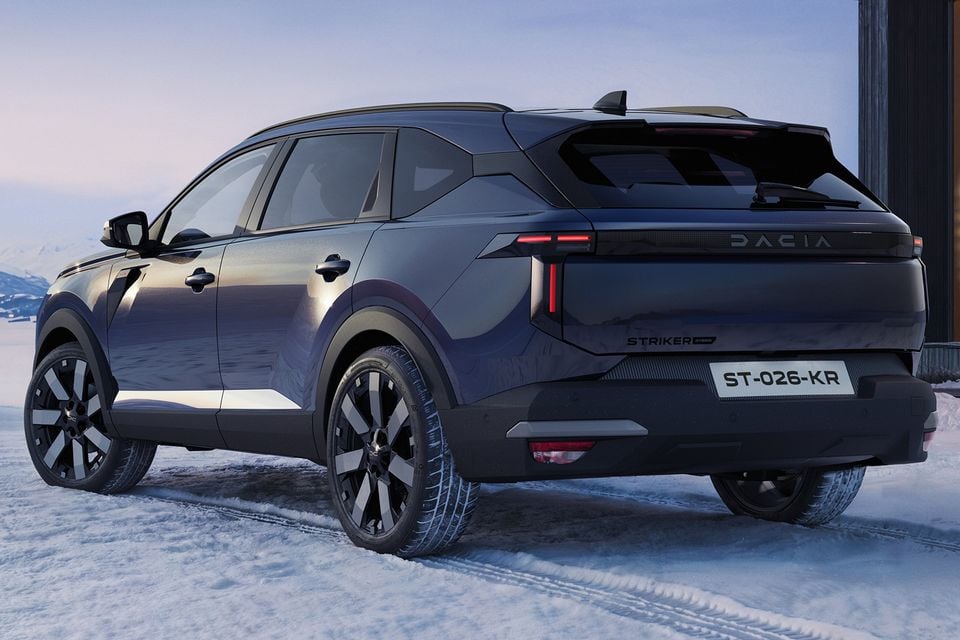
Measuring 4.62m from tip to tail, the Striker is the longest Dacia to date, eclipsing the Bigster, which is just 4.57m long, but stands considerably taller at 1.7m. Depending on the variant, the Striker rides on either 17-, 18- or 19-inch wheels.
The functional cabin is enlivened somewhat by a swathe of coloured fabric on the dashboard, and ’starkle‘ plastic on the doors and wraparound trim. There’s a ice scraper concealed in the dashboard, removable cupholders, and an optional sliding drawer under the centre arm rest.
Boot space is rated at 600L, and higher trim levels have a three-part multi-level boot floor that can be used to prevent items from sliding around or keep valuables out of sight.

A standard 7.0-inch optical reflection instrumentation display is positioned ahead of the driver, while a 10.1-inch infotainment touchscreen lives in the centre of the dashboard.
Among the available accessories are an aerodynamic roof box, and a pet seat. There’s also a water bottle, children’s blanket, and a multi-purpose storage net that doubles as a shopping bag, all of which can all clip into one of nine YouClip anchor points located throughout the interior.
In Europe, Dacia will offer the Striker with three drivetrains. Entry-level variants feature the 103kW Mild Hybrid-G or Eco-G setup that combines a 48V mild-hybrid system, a 0.8kWh battery, and 1.2-litre three-cylinder turbocharged engine that can consume either petrol or LPG.
Next up is the Hybrid 155, which has a 81kW 1.8-litre four-cylinder petrol engine, a 37kW electric motor, a high-voltage starter/generator, a 1.4kWh battery, and an automatic electric transmission with four gears for the petrol engine and two for the electric motor. Total output for this drivetrain is 114kW.
Lastly there’s the Hybrid 150 4×4 that features a 103kW/230Nm 48V mild-hybrid 1.2-litre three-cylinder turbo-petrol engine driving the front wheels via a six-speed dual-clutch transmission, and a 21kW/87Nm electric motor coupled to a two-speed transmission on the rear axle.
This system is rated at 110kW, and includes hill descent control, as well as five drive modes (auto, eco, snow, mud/sand, and off-road).
While Dacia is moving into larger vehicle categories, it is still pricing its products aggressively. In Europe, the Striker will start from €25,000 (A$41,050), undercutting the Skoda Octavia wagon by around €4000 (A$6500).
Dacia’s push upmarket has so far been successful, with the related Bigster leading the European C-segment (small) SUV sales race for the first half of 2026. The automaker is planning to release a third C-segment model to complement the Bigster and Striker some time in 2027.
Although Dacia isn’t present in Australia, one of its models is sold Australia, where the smaller Duster SUV is rebadged as Renault.