


In case you missed it, the next-generation Mitsubishi Pajero will soon make its global premiere after a five-year hiatus.
It’s the first new generation of Pajero since production of the fourth-generation NS-series ended in 2021, and will also fill a void left by the Pajero Sport which was discontinued in Australia in 2025.
The global teaser campaign for the fifth-generation Pajero is now in full swing and spy shots show it will take on a bigger, boxier persona to go with its go-anywhere body-on-chassis construction and turbocharged diesel engine performance – and a hybrid powertrain has also been confirmed.
Indeed, the new Pajero will be the first in two generations to be based on a ladder-frame chassis, after the third-generation model switched to a unibody (monocoque) design with an integrated ladder frame for increased torsional rigidity.
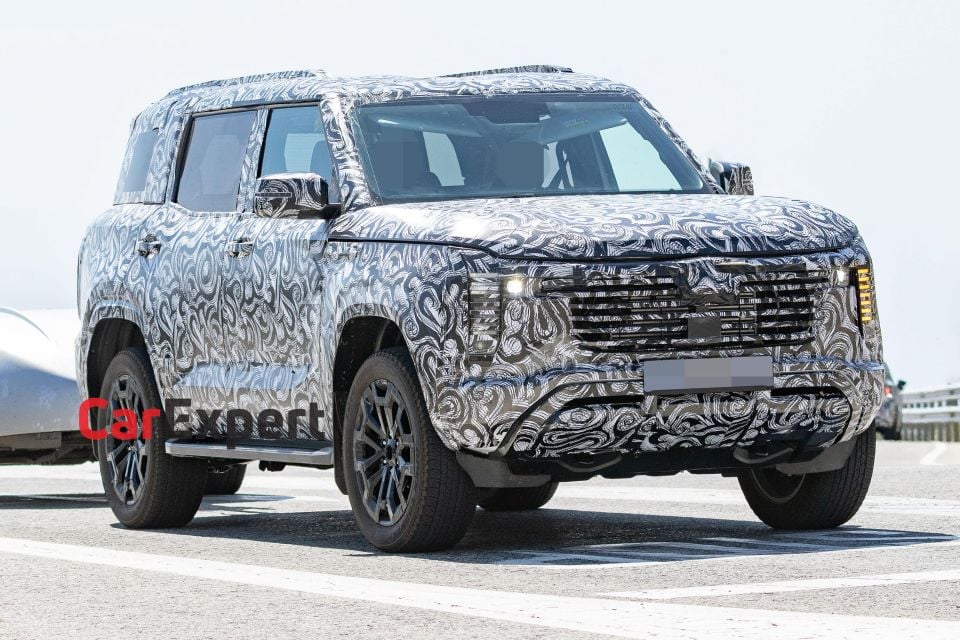
The platform is expected to be a heavily modified version of the sixth-generation Triton ute’s, fitted with multi-link coil-sprung – rather than leaf-sprung – rear suspension, and the new Pajero will be the first produced in Thailand, alongside the Triton.
That has led some to suggest it’s more appropriately described as a replacement for the Pajero Sport – which was based on and built alongside the previous Triton in Thailand, much as the Ford Everest and the related Ranger are – rather than the fifth generation of a model that has always been produced in Japan, at least for Australia.
Either way, here’s everything we know about the new Pajero, ahead of its imminent reveal.
What will power the 2027 Mitsubishi Pajero?
We expect the new Pajero to be launched with a version of the Triton’s 2.4-litre bi-turbo four-cylinder diesel engine which produces 150kW of power at 3500rpm and 470Nm of torque over 1500-2750rpm, and which is paired with six-speed automatic or manual transmissions in the ute.
However, we wouldn’t be surprised if it was tuned for more peak torque in this application and, like the old Pajero Sport, paired exclusively with an eight-speed automatic transmission and a Super-Select II 4WD system.
Either way, the new bi-turbo diesel will eclipse the outputs of both the single-turbo diesel Pajero Sport (133kW and 430Nm), and the Mk4 Pajero’s 3.2-litre DI-D diesel four (141kW/441Nm), and it’s also expected to beat their respective 3100kg and 3000kg towing capacities.

In terms of its large off-road SUV competitors, the top-selling Ford Everest is available with 125kW/405Nm 2.0-litre four-cylinder and 184kW/600Nm 3.0-litre V6 turbo-diesel engines, the Toyota Prado comes with a 150kW/500Nm 2.8-litre four-cylinder turbo-diesel, and the Isuzu MU-X can be had with 120kW/400Nm 2.2-litre and 140kW/450Nm 3.0-litre four-cylinder engines.
In what will be a first for the Pajero (and Pajero Sport), Mitsubishi’s new flagship SUV will also become available with a hybrid powertrain, following an additional 16 billion baht (~A$681 million) investment in the Japanese automaker’s Thai facilities until 2030.
The investment will reportedly be for the development and production of “electrified” vehicles, including the Pajero and unspecified pickup trucks. It’s unclear at this stage whether that means hybrid or plug-in hybrid (PHEV) powertrains, but it’s likely to be the latter, and a fully electric powertrain could follow.
Mitsubishi confirmed in 2023 it wasstudying both hybrid and electric powertrainsfor the Triton, which at the time were in the “advanced engineering phase”. The company had previously confirmed it was working on an electric ute for launch by 2028, but has gone quiet on that since then.
“In future, we think that BEV is also required for [a] pickup truck, but the question is timing: when we should introduce a BEV?” Mitsubishi’s global chief of engineering and product strategy, Hiroshi Nagaoka, told Australian media in 2023.
“And before a BEV, we also need to think about some other kind of electrified vehicle, such as a hybrid or a PHEV.”
He indicated a hybrid Triton would arrive first, and that the company was weighing whether to go electric or plug-in hybrid as a next step.
“Most likely we will go first with the HEV, then after that, maybe considering the battery improvement, PHEV, or battery EV,” said Nagaoka-san, noting that Mitsubishi wouldn’t use Alliance partner Nissan’s e-Power hybrid technology –a decision the company reiterated in 2025.
“If it’s a HEV we can use the current frame. So in the short term, that would be a very good solution,” he said, noting an electric or PHEV powertrain would require an extensive reworking of the platform.
In 2023, Mitsubishi saidit didn’t see a lot of demand for PHEV pickups, but the market has changed since then, including the release of the plug-in hybrid BYD Shark 6 dual-cab to critical acclaim, quickly followed by PHEV versions of the top-sellingFord Ranger, as well as theGWM Cannon AlphaPHEV.
The conventional hybrid version of the GWM Tank 500 would have been a logical rival for a hybrid Pajero, but it’s being phased out in Australia, where Toyota recently launched a hybrid version of itsLandCruiser 300 Series.
It’s unclear whether Mitsubishi’s upcoming electrified Pajero and Triton will use a diesel or a petrol engine. The Shark, Ranger and Cannon Alpha PHEVs all incorporate a petrol engine, which would likely be more desirable for the US market where Mitsubishi is reportedly considering selling the new Pajero.
Diesel hybrids don’t exist yet in Australia, but that will change when Chery launches its oil-burning StockmanPHEV dual-cab later this year, followed by a petrol PHEV version, and GWM has also confirmed it’s developing diesel hybrid and diesel PHEV powertrains which will enter production in 2027.
How much will the 2027 Mitsubishi Pajero cost?
The new Pajero may revive an iconic off-road nameplate, but it will need to undercut seven-seat off-road SUV stalwarts like the Everest and Prado to be successful in Australia – not so much the larger and more expensive new Nissan Patrol or the existing LandCruiser 300 (priced from $99,340).
While the discontinued Pajero Sport continues to be available in four grades (GLX, GLS, Exceed and GSR – variant names that will reportedly carry over to the Pajero) priced from $51,540 before on-road costs, we expect the new Pajero to be more expensive.
That’s because it will bring a dramatic uptick in technology, safety and equipment compared to both the old Pajero and Pajero Sport, reportedly including a digital recreation of the iconic triple analogue ‘Multi Meter’ instruments seen in previous generations of the Pajero.
But the new Pajero won’t go significantly upmarket in price, given the popular MU-X is priced from $49,900 and the Everest starts at $58,990, while the Japan-built Prado’s base price is higher at $73,200.
Known as Montero in North America, Spain and Latin America, and the Shogun in the UK, the Mitsubishi Pajero generated more than 3.3 million sales globally over four generations and 40 years following its launch in 1981.
According to reports, the new Pajero will be revealed in Tokyo on September 2, before opening for pre-orders in Australia in October, and arriving here in December, in both five-seat and seven-seat forms.
Australia will be one of the key markets for the new model, so watch this space for more news as it breaks.