


Following the lead of several of its rivals, Mitsubishi has decided to give its Triton ute a unique Australian twist.
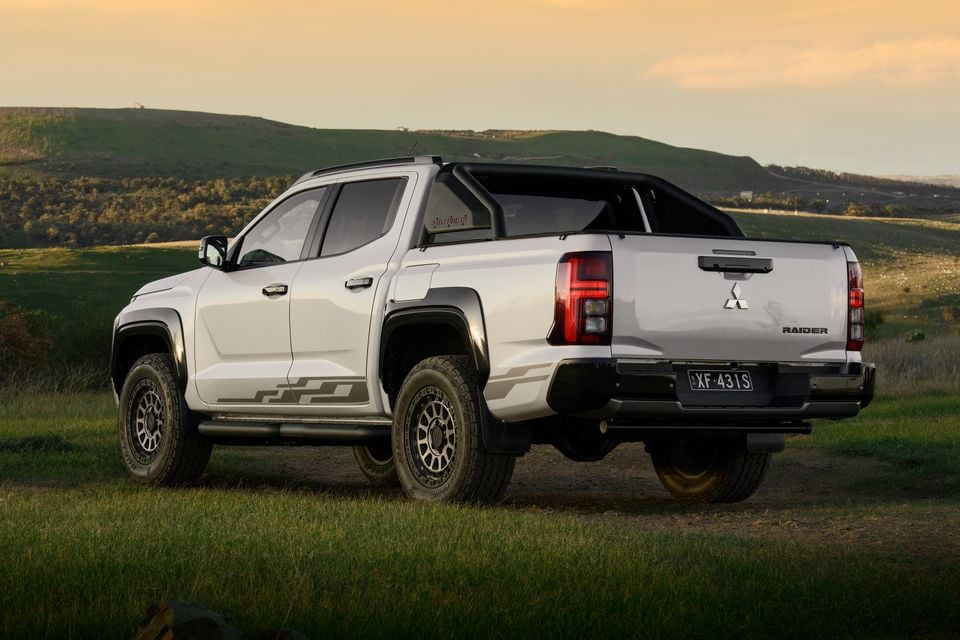
The thing is, what makes it truly unique is in the eye of the beholder. See, Mitsubishi enlisted Premcar to develop and assemble the new Triton Raider, and the Victorian-based engineering firm has maximised its off-road capabilities by adding several bespoke parts, which underwent 40,000km of testing to confirm their performance and durability.
The Raider is based on the top-spec Triton GSR, and changes include modified Monroe shock absorbers, aftermarket-style ROH alloy wheels with Bridgestone all-terrain tyres, improved underbody protection, a red-accented sports bar, and an array of ‘Raider’ badges inside and out.
While that’s new for the Triton, it sounds a lot like the modifications Premcar makes to the Navara to create the Warrior, which proved popular in previous-generation guise and will be replaced by a new Navara Warrior later this year, also developed by Premcar.
The key there is that the Triton and Navara are now twins, and the regular Navara already gets a bespoke Premcar-developed chassis tune to set it apart. Still, Mitsubishi and Premcar insist that the Raider and Warrior are completely separate, and there’s no doubt this is among the most hardcore Tritons sold here in some time.

There’s been no power boost, which means the Raider competes directly with other lightly modified, off-road-ready utes. The most notable is the Isuzu D-Max Blade, developed by Walkinshaw Automotive and featuring many enhancements similar to Mitsubishi’s offering.
There’s also the Ford Ranger Tremor, a more light-duty off-road alternative to the full-blown Raptor. Of course, the incoming Navara Warrior will also be one to keep an eye on.
CarExpert was among the media invited to Adelaide for a first drive of the new Triton Raider both on- and off-road – including at the same 4×4 facility where this reviewer first drove the D-Max Blade.
How does it stack up, and are the new bits and pieces worth the extra cost?
How much does the Mitsubishi Triton cost?
Sitting at the very top of the Triton model range, the Raider is priced at $74,990 drive-away.
Model | Price before on-road costs |
|---|---|
2026 Mitsubishi Triton GLX 4×2 single-cab/chassis auto | $37,090 |
2026 Mitsubishi Triton GLX 4×2 dual-cab pickup auto | $44,190 |
2026 Mitsubishi Triton GLX 4×4 single-cab/chassis auto | $44,440 |
2026 Mitsubishi Triton GLX 4×4 Club Cab chassis auto | $47,590 |
2026 Mitsubishi Triton GLX 4×4 dual-cab/chassis manual | $47,940 |
2026 Mitsubishi Triton GLX 4×4 dual-cab/chassis auto | $50,190 |
2026 Mitsubishi Triton GLX+ 4×4 Club Cab pickup auto | $50,690 |
2026 Mitsubishi Triton GLX 4×4 dual-cab pickup auto | $51,640 |
2026 Mitsubishi Triton GLX+ 4×4 dual-cab/chassis auto | $52,690 |
2026 Mitsubishi Triton GLX+ 4×4 dual-cab pickup auto | $53,990 |
2026 Mitsubishi Triton GLX-R 4×4 dual-cab pickup auto | $57,440 |
2026 Mitsubishi Triton GLS 4×4 dual-cab/chassis auto | $58,590 |
2026 Mitsubishi Triton GLS 4×4 dual-cab pickup auto | $60,140 |
2026 Mitsubishi Triton GSR 4×4 dual-cab/chassis auto | $62,590 |
2026 Mitsubishi Triton GSR 4×4 dual-cab pickup auto | $65,590 |
2026 Mitsubishi Triton Raider 4×4 dual-cab pickup auto | $74,990 (drive-away) |
The Raider’s key rivals are other off-road-ready utes with no engine performance upgrades. These include the Ford Ranger Tremor, priced at $75,090 before on-road costs, and the Walkinshaw-tuned Isuzu D-Max Blade, priced at $80,900 before on-roads.
Find your perfect new car with CarExpert
Nissan has yet to confirm pricing for its next Navara Warrior, but since we know it’ll again be based on the top-spec Pro-4X, we have a point of comparison. That model costs $68,418 before on-roads, nearly $3000 more than the Triton GSR, so expect a similar difference between the Raider and Warrior.
To see how the Mitsubishi Triton stacks up against the competition, use our comparison tool
What is the Mitsubishi Triton like on the inside?
The Raider brings no major interior enhancements to the Triton, but what it lacks in luxury, it makes up for in functionality.
The real enemy of the Triton’s interior is comparison, because there’s no denying it isn’t as flashy inside as a more expensive ute like a Ranger, Volkswagen Amarok or, to a lesser degree, a Toyota HiLux. Only when you’re actually behind the wheel will you realise the benefits of Mitsubishi’s old-school vibe.
For one, the 9.0-inch infotainment touchscreen is comparatively small, but that means it’s far less imposing than the Ranger’s 12.0-inch vertical screen. Instead, this unit sits neatly atop the dashboard and is easy to reach while you’re driving. It also supports wireless smartphone mirroring despite looking a bit old.
Its simple graphics and layout also make it easy to find and adjust settings, though most vehicle settings are found in the instrument cluster, which we’ll detail in a moment. Aiding the legibility of the infotainment system is a clearly labelled array of buttons and knobs, though they’re annoyingly all piano-black.
The biggest benefit of this smaller screen, however, is arguably that it frees up plenty of space below for the climate system. It’s always a relief to get a new car with a physical bank of controls, and the Triton’s climate switches are all large and easy to use.
Moving across to the instrument cluster reveals two large dials separated by a 7.0-inch display. The dials present well in a refreshingly analogue way, while the screen is easy enough to navigate via the steering wheel buttons.
It offers a selection of menus for most vehicle functions, including trip computers and safety systems. The latter has even received a small upgrade: it now takes only two button presses to disable the driver attention monitoring system – a helpful simplification for something you’ll likely do often.
Otherwise, those steering wheel buttons are all finished in dull black plastic and feel nice to use. That plastic vibe is very much a theme in the Triton, because most surfaces inside look like scratchy black plastic, even if areas like the dashboard are actually soft to the touch.
That does contribute to its generally down-market appearance, but it does mean the cabin is likely to withstand a fair amount of abuse. Mitsubishi’s material choice here has actually improved, as the GSR’s glossy plastic centre console slab has been replaced by something much less scratch-prone. Any images contradicting that show a pre-production Raider.
This was a common complaint among media and customers alike, so we’re glad Mitsubishi has taken some feedback on board. On that note, the Raider’s GSR basis makes it feel fairly premium, even though there are only a few Raider-specific items inside.
The only identifying features are the Raider logos glued to the centre console and stitched to the front head restraints. Some may want more, but we’re glad Premcar hasn’t messed with the GSR’s interior strengths.
The seats, for instance, are quite comfortable by ute standards. They’re finished in what appears to be quality leather, they feel supportive, and they offer heating as standard. It’s a shame there’s no ventilation though, and only the driver gets power adjustment.
Elsewhere, the steering wheel feels as nice as ever with its perforated leather finish, and the orange stitching on the dashboard, seats and steering wheel is a welcome hint of colour in an otherwise monotone environment.
As for storage, the Raider is no less practical than any other Triton. Highlights include cupholders that slide out from below the air vents at either end of the dash, and the two-tier passenger-side glovebox that has become a mainstay of the Triton GLS and up.
There’s also a cubby below the climate system that houses a wireless phone charger, though there are also USB-A and -C ports nearby if you prefer wired charging. These are all within close proximity of the Triton’s simple driving controls.
We like that the Triton still has a large, traditional gear selector, as well as an easy-to-reach dial to switch between the four 4×4 modes offered by the Super Select II system. The rear differential lock is also operated by a simple-as-you-like button ahead of the shifter.
Controls like these, which require no thought to locate and use, are immensely helpful when off-roading, as they allow the driver to spend more time thinking about the obstacle ahead rather than figuring out their vehicle.
Stepping into the rear of the Raider – and the front, for that matter – is as simple as it gets for a dual-cab ute, thanks to monstrous metal side steps that feel like they could withstand the apocalypse. There are also nicely placed grab handles inside to help you vault in.
Once in the back, there’s loads of space all round. Headroom and legroom are both good if you’re 173cm tall like me, and the leather-appointed bench seat is appropriately soft – grown adults will have no issue fitting back here. But squeezing in three abreast is always going to be somewhat squishy.
Amenities include roof-mounted air vents controlled by a roof-mounted switch panel (but with no third climate zone), two USB ports on the back of the centre console, and a fair few pockets on the front seatbacks.
There’s also a thick fold-down armrest with cupholders, bottle holders in the doors, and a little extra storage space if you fold the bench seat forward.
Out back, there have been no Raider-specific changes, apart from the red backing to the Mitsubishi logo on the sports bar. The tub is still spacious and practical, with the manual tailgate made a tad easier to open and close by the addition of a pair of hydraulic struts.
There’s no tonneau cover as standard, but we’d recommend the electric roller cover option if you want one, even though it reduces storage space. The soft cover is just too much of a hassle to pull closed, especially when it’s slightly shrunk from sitting in the sun.
Still, a tub-liner is standard, and there are four tie-down points to secure your load. That red-accented sports bar is new for the Raider, as is a thick red bash plate under the engine.
So there are no substantial changes to the Triton’s interior, but that’s not what the Raider is all about.
Dimensions | Mitsubishi Triton Raider |
|---|---|
Length | 5350mm |
Width | 1930mm |
Height | 1832mm |
Wheelbase | 3130mm |
Tub length | 1555mm |
Tub width | 1545mm |
Tub depth | 526mm |
To see how the Mitsubishi Triton stacks up against the competition, use our comparison tool
What’s under the bonnet?
Power outputs are unchanged for the Raider. Its 2.4-litre four-cylinder twin-turbo diesel engine produces 150kW of power and 470Nm of torque, with drive sent to a full-time four-wheel drive system through a six-speed automatic transmission.
Specifications | Mitsubishi Triton Raider |
|---|---|
Engine | 2.4L 4cyl twin-turbo diesel |
Power | 150kW |
Torque | 470Nm |
Transmission | 6-speed auto |
Drive type | ‘Super Select II’ full-time four-wheel drive |
Fuel economy (claimed) | 7.7L/100km |
CO2 emissions (claimed) | 203g/km |
Fuel tank | 75L |
AdBlue tank | 17L |
Kerb weight | 2195kg |
Payload | 990kg |
Braked towing capacity | 3500kg |
Gross vehicle mass (GVM) | 3185kg |
Gross combination mass (GCM) | 6200kg |
We didn’t get enough time in any one Triton to record a representative real-world fuel economy figure on Mitsubishi’s launch. That said, we did see figures around 8.6L/100km in a couple of vehicles after extensive on- and off-road driving.
For context, our previous Triton reviews have returned economy figures hovering around the 8.0L/100km mark, which average for its class.
To see how the Mitsubishi Triton stacks up against the competition, use our comparison tool
How does the Mitsubishi Triton drive?
Here’s where Premcar has properly gone to work, though its efforts to beef up the Triton take a second to become apparent once you get moving.
That’s mostly because there have been no mechanical changes, which means the Triton is still far from a drag-racing weapon. Of course, it isn’t meant to be, but a little extra pep would go a long way in boosting the ute’s appeal.
It’ll get up to speed without issue, but it becomes quite gruff when you adopt a heavy right foot. Mind you, it doesn’t feel quite as strained as the similarly modified D-Max Blade does, and Premcar’s changes haven’t had much of an effect on the Triton’s perceived weight.
The transmission is still competent in its behaviour, and it never made itself known when tackling Adelaide’s traffic or off-road tracks. Gear choice is solid, and it kicks down nicely if you need to make an overtake.
That all makes for a ute that’s easy to drive in most sealed-surface environments, but it’s when you spend time at speed that you’ll start to notice the Raider-ness of it all. First is the steering, which has been tuned for improved overall feel to compensate for the wider wheel-and-tyre combo.
On the road, this gives the Raider a direct steering response that feels appropriately weighted for its stature, while avoiding the vagueness sometimes found in ladder-frame vehicles. It’s hard to discern whether it’s any more communicative than the normal GSR, but it’s a pleasant steer nonetheless.
That naturally ties into the Raider’s bespoke suspension setup. The on-road highlight is the ute’s newfound composure, with surprisingly little body roll when taking bends at pace.
This is despite the increased ride height, which we’d reasonably expect to result in pronounced body movement given the higher centre of gravity. Not so here, and the result is a Triton that feels impressively confident when the speed picks up.
In fact, the all-terrain rubber loses grip well before the chassis shows any real signs of struggle. That’s quite good for a dual-cab ute, and it’s a noticeable improvement over the experience you’ll get in other standard-duty Tritons.
From expert reviews to the right deal
CarExpert brings together reviews, research tools and trusted buying support, guiding you from research to delivery with confidence.
The overall ride, meanwhile, is unmistakably that of a body-on-frame commercial vehicle, yet it’s been reasonably well refined. It’ll still feel firm as it bounces about over bumps, but the Monroe dampers do a good job of keeping the tyres in contact with the pavement, creating stability.
All of the Raider’s other on-road behaviours aren’t all that different to the regular Triton’s. Its brakes feel solid, road noise is acceptable despite the chunkier rubber, and most of its safety systems work as well as they always have – except the driver monitor.
Without harping on about it, it’s still too sensitive. There’s been a small update to reduce its sensitivity, which has led to a slight improvement, but it’s still far from ideal. Disabling it has at least been simplified, as detailed earlier, but you’ll have to do it every time you drive.
But Mitsubishi didn’t enlist Premcar to just make the Triton handle better on sealed surfaces. The Raider hits its stride when the road ends, and it turns out to be quite an impressive vehicle on the rough stuff.
It isn’t like the Triton has been given a drastic overhaul that has changed it in every way. Premcar has simply leveraged the true capabilities of Mitsubishi’s ute in a way that doesn’t feel artificial or forced.
For one, the roughly 20mm ride height lift may not sound huge on paper, but it’s made a big difference in the real world. We lost count of how many times we thought the ute would bottom out or scrape over serious mounds and holes, only for it to walk on through as if on flat ground.
Of course, it will still belly out if you’re too quick or not careful enough, so it’s always a bonus to have extra protection under the car for the hairier moments, as the Raider does.
Additionally, the chunky all-terrain rubber proves very good at clawing the ute out of mud holes and up loose climbs. Premcar says it evaluated four different tyre brands before landing on Bridgestone, which seems to have been a good choice.
The Dueler A/T 002 tyres and the lifted suspension has allowed the Triton to show off its true colours. Throw it in the lowest of the four gearing options, and it simply shrugs off most off-road obstacles without breaking a sweat.
If you do get stuck on an uphill mogul, one press of a button will lock the rear differential, allowing the Raider to crawl right out. Premcar’s changes appear to be thoughtful modifications that work harmoniously with Mitsubishi’s own systems.
On top of that, you have the advantage of driving in four-wheel drive on sealed surfaces, something you can’t do in a HiLux or a D-Max. Combined with its all-terrain tyres, that makes the Triton feel surprisingly confident on higher-speed dirt roads.
If you’re so inclined, you can also throw it in 2H (high-range rear-wheel drive) for a bit of controlled sliding action. Or so we’re told.
Overall, the Raider’s additions are nothing if not well-considered, and they complement the Triton’s native capabilities very nicely.
There are no real compromises, either – the only thing you might complain about is the slightly reduced payload, but it’s only 40kg less than a normal GSR.
You could certainly push the Raider harder than we did, too. It gives you the confidence to tackle obstacles that you’d otherwise avoid, which is exactly what a purpose-built off-road ute should do.
Does it outperform a Blade? No, not necessarily, but it’s splitting hairs when it comes to driving – the cost difference in favour of the Raider will likely be the deciding factor for many.
Off-road dimensions | Mitsubishi Triton Raider |
|---|---|
Track front and rear | 1590mm (front) |
Ground clearance | 243mm |
Approach angle | 32.7º |
Departure angle | 24.1º |
Ramp breakover angle | 24.8º |
To see how the Mitsubishi Triton stacks up against the competition, use our comparison tool
What do you get?
The Raider sits at the top of the six-variant Triton range, based on the highly equipped GSR.
2026 Mitsubishi Triton GLX equipment highlights:
- 17-inch steel wheels
- Highway terrain tyres on 4×2
- All-terrain tyres on 4×4
- Full-size spare wheel
- Easy Select 4WD (4×4)
- Halogen headlights
- Automatic high-beam
- Heavy-duty three-leaf rear suspension
- Black fabric upholstery
- Manually adjustable driver’s seat with power lumbar
- Vinyl flooring
- 7.0-inch instrument cluster screen
- 9.0-inch touchscreen infotainment system
- Wireless Apple CarPlay
- Wired Android Auto
- Bluetooth
- Satellite navigation
- 2-speaker sound system (single-cab/chassis)
- 4-speaker sound system (dual-cab pickup)
- Air-conditioning (single-cab/chassis)
- Single-zone climate control (dual-cab pickup)
- Floor console box with lid
- 2 x cupholders
- 2 x bottle holders
- Sunglasses holder
- Second-row bench with centre armrest
- Seatback pocket
- 1 x front USB-A outlet
- 1 x rear USB-A outlet
- 1 x front USB-C outlet
- 1 x rear USB-C outlet
- Keyless entry
Triton GLX+ adds:
- 17-inch alloy wheels with all-terrain tyres
- Locking rear differential
- Front fog lights
- Side steps
- Black fabric upholstery with silver stitching
- Rear privacy glass
- DAB+ digital radio
- 4-speaker sound system
- Single-zone climate control
- Dual-strut tailgate assist system (pickup)
Triton GLX-R adds:
- Black 18-inch alloy wheels with highway terrain tyres
- Standard-duty three-leaf rear suspension
- Super Select 4WD II
- Black sports bar
- Door body mouldings
- Carpet flooring
- Leather-wrapped steering wheel
- Hill descent control
- Terrain control
- Dual-strut tailgate assist system
Triton GLS adds:
- Grey 18-inch alloy wheels with highway terrain tyres
- LED headlights
- Power-folding heated side mirrors
- Sports bar delete
- Tub liner (pickup)
- Auto-dimming rear-view mirror
- Leather-wrapped gear selector
- Leather-wrapped handbrake
- Wireless phone charger
- 6-speaker sound system
- Upper glovebox
- 2 dash-mounted cupholders
- Dual-zone climate control
Triton GSR adds:
- Black 18-inch alloy wheels with highway terrain tyres
- Yamaha performance damper
- Roof rails
- Fender flares
- Sailplane
- Carpet floor mats
- Orange interior stitching
- Leather-appointed upholstery
- Power-adjustable driver’s seat
- Heated front seats
- Mitsubishi connected services
Triton Raider adds:
- Bronze 18-inch ROH ‘Assault’ alloy wheels
- Bridgestone Dueler A/T 002 all-terrain tyres
- 20mm track width increase
- Premcar-tuned Monroe shock absorbers
- 25mm front lift
- 15mm rear lift
- Mitsubishi-branded sports bar
- Side protection bars
- Raider-branded bash plate
- ‘Ralliart-inspired sandstorm decals’
- Raider console badge
- Raider headrest embroidery
To see how the Mitsubishi Triton stacks up against the competition, use our comparison tool
Is the Mitsubishi Triton safe?
The Mitsubishi Triton has a five-star ANCAP safety rating based on testing conducted in 2024.
Category | Mitsubishi Triton |
|---|---|
Adult occupant protection | 86 per cent |
Child occupant protection | 89 per cent |
Vulnerable road user protection | 73 per cent |
Safety assist | 70 per cent |
Standard safety equipment includes:
- 8 airbags, including:
- Autonomous emergency braking (AEB)
- Pedestrian detection
- Cyclist detection
- Junction assist
- Adaptive cruise control
- Blind-spot monitoring
- Driver attention monitoring
- Emergency lane-keeping
- Front and rear parking sensors
- Front cross-traffic alert
- Intelligent speed limiter
- Lane-keep assist
- Multi-collision brake
- Rear autonomous emergency braking (pickup only)
- Rear cross-traffic alert
- Reversing camera
- Surround-view camera (pickup only)
- Trailer stability assist
- Tyre pressure monitoring
Triton GLX-R adds hill descent control.
To see how the Mitsubishi Triton stacks up against the competition, use our comparison tool
How much does the Mitsubishi Triton cost to run?
The 2026 Mitsubishi Triton is backed by a five-year, 100,000km standard warranty, which is extended by 12 months or 20,000km every time the ute is serviced on time at a Mitsubishi dealer, up to the 10-year/200,000km mark.
Servicing and Warranty | Mitsubishi Triton |
|---|---|
Warranty | 5 years/100,000km, service-activated up to 10 years/200,000km |
Roadside assistance | 10 years (service-activated) |
Service intervals | 12 months or 15,000km |
Capped-price servicing | 10 years (service-activated) |
Average annual service cost | $702.3 |
Total capped-price service cost | $7023 |
Mitsubishi’s capped-price service schedule for the Triton is detailed below:
Service | Price |
|---|---|
1yr or 15,000km | $489 |
2yrs or 30,000km | $489 |
3yrs or 45,000km | $489 |
4yrs or 60,000km | $599 |
5yrs or 75,000km | $639 |
6yrs or 90,000km | $850 |
7yrs or 105,000km | $719 |
8yrs or 120,000km | $980 |
9yrs or 135,000km | $869 |
10yrs or 150,000km | $900 |
Even with its service-activated clause, Mitsubishi’s decade-long aftersales program is among the best in Australia. It’s far ahead of the Raider’s direct rivals, with Ford offering five-year coverage and Isuzu offering six – though Nissan does offer a similarly long warranty.
In terms of service pricing comparisons, we’ll look only at the first five years of Triton maintenance, which total $2705. That’s more than the D-Max at $2445, which has its first five services capped at $489 each, and both are well above the Ranger’s $1596 five-year service plan.
The Nissan Navara, meanwhile, costs $2495 to service over five years, with each annual service capped at $499.
To see how the Mitsubishi Triton stacks up against the competition, use our comparison tool
CarExpert’s take on the Mitsubishi Triton Raider
While it isn’t revolutionary, the Raider is a logical, well-engineered addition to the Triton lineup.
Mitsubishi needed something to give its ute range a bit more spice, and the changes Premcar has rolled out certainly make the Triton more interesting. It was already a strong ute, and this just brings out its off-road chops.
Now, for the elephant that will no doubt be in the room: “Why would I spend this much when I can buy a cheaper Triton and put my own shocks and tyres on?” I hear you ask. There’s more reason than you’d think.
For one, Premcar is an established engineering company with extensive experience doing exactly this. A product like the Triton Raider doesn’t even get past the talking phase without Mitsubishi’s blessing, so the brand’s trust in Premcar should reassure you that this is a quality product.
Further, the Raider offers the advantage of aftermarket-style parts specifically chosen and tuned to suit the Triton. Wheels and tyres are one thing, but you aren’t going to get the same level of attention to detail, such as a retuned stability control system, when you buy suspension off the shelf.
Finally, it’s impossible to ignore the fact that all these modifications are backed by Mitsubishi’s extensive new-car warranty. Ten years of warranty and roadside assistance is huge, and it’s far greater peace of mind to know that all these ‘mods’ are covered by a factory warranty.
Then consider that the Raider is cheaper than both the Blade and the Tremor, and that it will almost certainly be cheaper than the new Navara Pro-4X Warrior, and there are more brownie points for value.
Of course, the Raider isn’t perfect. The driver monitor still needs work, and it could do with a tad more power. But those are minor niggles in a factory-integrated package that is very, very good.
We walked away quite impressed with what Premcar and Mitsubishi have cooked up. Only time will tell if the buying public agrees, but the Raider is well worth a look if you want a ready-made off-road hay hauler.
CarExpert can save you thousands on a new Mitsubishi Triton. Click here to get a great deal.
Click the images for the full gallery