


Several younger Chinese brands are consistently outperforming Renault on the Australian sales charts, but Renault’s local arm maintains it’s well-positioned to remain afloat in an increasingly competitive market.
While Renault is promising a raft of new or refreshed models over the next six months, starting with the Scenic E-Tech, its sales so far in 2026 are down on the same period in 2025, while sales of cheaper brands – particularly from China – are skyrocketing locally.
Speaking to media at the local launch for the Scenic E-Tech, Renault Australia general manager Glen Sealey said that “Renault, as a brand, is really in a good position to survive in a market like [Australia]”.
When challenged about whether Renault was content to merely survive rather than thrive, Mr Sealey doubled down.
CarExpertcan save you thousands on a new car. Clickhereto get a great deal.
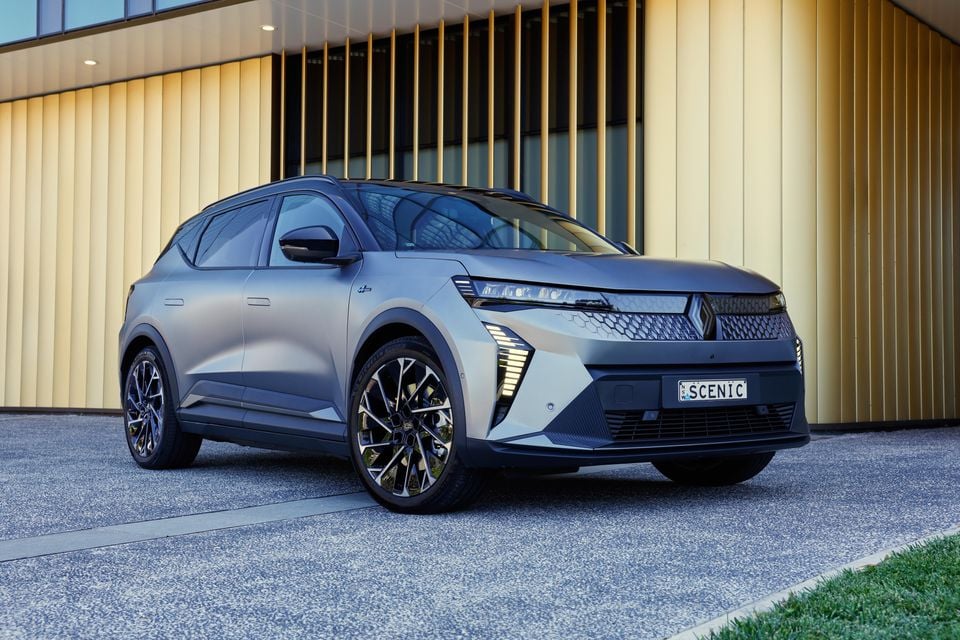
“I would say survive. This is an aggressive market; the top 10 always make up 70 per cent. That leaves 60 brands competing for roughly 360,000 cars a year. That’s the reality of life,” he said.
“If you’re going to compete in that, [selling] 6000 cars per brand on average, can you survive on 6000 cars a year? We can.”
If 6000 cars a year is the target for Renault Australia, it has serious work to do in order to get on track. The brand delivered 4569 cars here in 2025, down 17.8 per cent on 2024.
It was the brand’s worst result in 14 years, and the new year has gotten off to an inauspicious start – its sales in the first two months of 2026 were also down 17.8 per cent on the same period in 2025.
In the meantime, Renault was outperformed on the sales charts last year by six Chinese brands that all offer cheaper vehicles: GWM (52,809), BYD (52,415), MG (41,298), Chery (34,889), LDV (14,108), and Geely (5010) – the latter even missed two months of sales, as it launched in late February.

While Renault’s sales are down, many of those Chinese brands are up. BYD is up 161 per cent year-to-date on 2025, Chery is up 99.2 per cent, and GWM is up 28 per cent, though MG and LDV are down slightly.
But Mr Sealey defended Renault’s higher pricing and insisted there’s an unavoidable price to pay for European vehicles, even as Chinese brands gain market share.
“As a brand, we’ve made that decision. We want to bring – in the case of the Scenic – good, premium vehicles with European design, European calibration, European feel, European handling, and offer something different into the market,” he said.
“But guess what? In life, you get what you pay for. That’s the unfortunate part.
“Not everything in life is about price … you could say an [Apple] watch is much cheaper than a Rolex Daytona, but people still line up to buy the Rolex Daytona.”
Currently, Renault’s cheapest model on sale in Australia is the Duster, priced from $31,990 before on-roads. None of the cheapest models from those six Chinese brands exceed $30,000, except for LDV.
LDV, primarily a commercial vehicle brand, competes with Renault in the van market. Its cheapest model is the G10 at $42,102 drive-away, undercutting Renault’s Kangoo, which starts at $44,990 before on-roads.
Crucially, Renault’s electric vehicles (EVs) – primarily the Megane E-Tech and Scenic E-Tech SUVs – are far more expensive than many Chinese alternatives. More budget-friendly Renault EVs, like the Renault 4 E-Tech and Renault 5 E-Tech, exist overseas, but they’re unlikely to be brought here any time soon.
Still, Mr Sealey says there are several factors placing Renault models ahead of many other Chinese brands, and maintains it’s prepared to introduce models to meet market demand.
“That emotional design coming through will shine through. Technology, user-friendly technology; it’s eyes on the road, muscle memory’s there, everything’s easy to use, it’s not intimidating, it’s not minimalistic, and it’s not all on screens. There’s an appeal for that,” Mr Sealey said.
“And then finally, drivetrain. Not everyone wants electric, not everyone wants hybrid, and not everyone wants [internal combustion] – we’ve got a drivetrain for everyone, and we won’t leave anyone behind.
“If the market [share] goes to 50 per cent EV, guess what? We’ve got a cupboard full of cars we can access. If the market stays at 10 per cent EV, and just remains a hybrid market, we’ve got drivetrains in cars that we can access.”
Renault’s confidence comes despite the fate of fellow French brand Citroen in recent memory. Citroen announced its departure from the Australian market in August 2024, amidst extremely low sales – recording only 87 deliveries between January and July 2024 – as its importer, Inchcape, worked to introduce a new Chinese brand, Deepal.
MORE: Renault’s coolest EVs blocked by Australian safety rules
MORE: Citroen leaving Australia after more than 100 years, importer focusing on Peugeot