


Looking at fuel prices at the moment, we have one word: Yikes!
Well, we could think of some other one-syllable exclamations, but suffice it to say that fuel prices are high… if your local servo even has any fuel!
Now, this could just be a blip. Middle Eastern conflicts typically don’t wrap up quickly, mind you, but spikes in fuel prices tend to be just that – spikes, before fuel prices come back to Earth.
CarExpert can save you thousands on a new car. Click here to get a great deal.

But anecdotally, over the past few weeks we’ve seen heightened interest in more fuel-efficient vehicles and particularly electric vehicles (EVs). We imagine there are plenty of buyers who were on the fence about shifting to a hybrid, plug-in hybrid (PHEV) or EV who are now much more willing to take the plunge now that diesel is over $3/litre in many places and petrol isn’t far behind.
Sick of paying too much at the servo? Here are some of our top picks for fuel-efficient vehicles priced under $50,000 before on-road costs.
Alborz Fallah, Founder
MG ZS
Of course there’s always the BYD Atto 1, but if you need a car with space, go buy a new MY25-plated MG ZS Vibe which the Chinese brand is currently running out for $22,990 drive-away.
It’s genuinely insane value for money and although its fuel economy may not be the absolute best at 6.7L/100km, the money you save on buying it will make up for the extra fuel you’ll have to pay for.
MORE: Explore the MG ZS showroom
Marton Pettendy, Managing Editor
Leapmotor B10
It’s no surprise that demand for EVs is spiking amid the explosion in fuel prices and the increasing likelihood of fuel shortages.
Even the most ardent EV critics will admit there’s never been a better time to buy an EV, especially if you’ve got rooftop solar panels and a home storage battery, which will not only eliminate the bowser blues but provide free local transport, at least in theory.
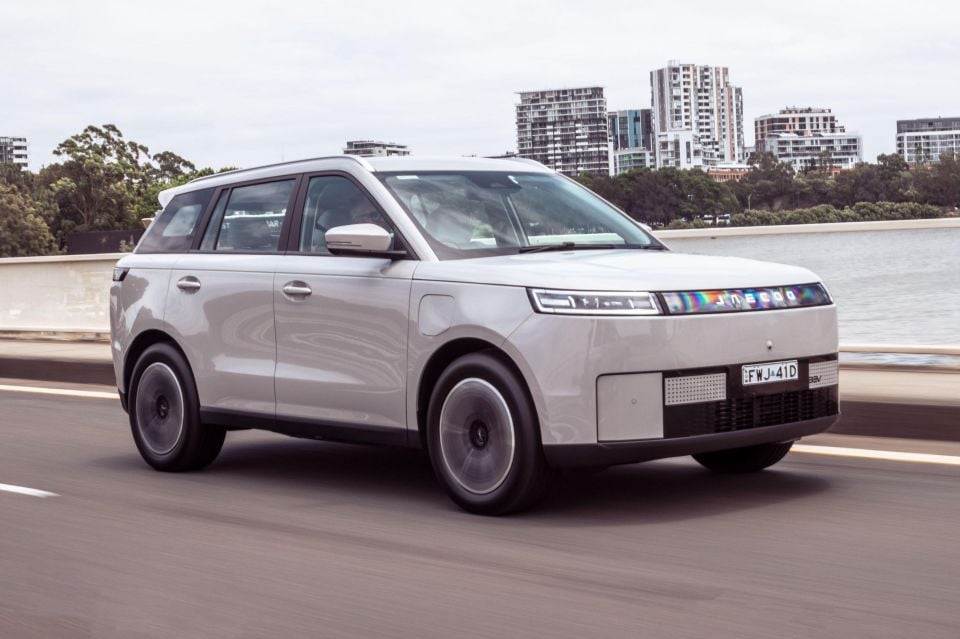
And if you’re after a cheap EV that’s not terrible to drive, my pick is the Leapmotor B10, a new Chinese small electric SUV that offers a decent range and great value for money at $38,990 drive-away.
It’s not perfect and the lane-keeping system might drive you crazy, but in my book the B10 rides and handles better than any other EV priced under $40,000 – and perhaps even $50k.
MORE: Explore the Leapmotor B10 showroom
James Wong, Marketplace Editor
Toyota Yaris Ascent Sport Hybrid
Understanding that fuel prices are nothing short of chaotic right now, the main reason I didn’t choose a plug-in vehicle is due to the fact not everybody has the ability to charge at home – and it defeats the purpose of an EV or plug-in hybrid (PHEV) if you’re relying on expensive public charging or petroleum.
Further, in times of uncertainty or an all-out crisis like we’re experiencing now, you want your essential tools – ie: transport – to be efficient, dependable, and cost-effective across the board.
As such, the most affordable Toyota Yaris, at just $28,990 before on-road costs, offers incredible fuel economy which gets you almost 1000km for every fill of its teeny 36-litre fuel tank. And being a Toyota, it should be just about bulletproof.
Further, Toyota’s capped-price servicing is among the cheapest at this end of the market, at $265 a pop for each 12-month/15,000km visit for the first five years. It’s easily one of the most cost-efficient new cars all round.
Cons? It’s a bit pokey inside, and the no-frills angle that’s endearing to some will grate others. But if you travel alone often, do you really need much more than the essentials in times like these?
MORE: Explore the Toyota Yaris showroom
William Stopford, News Editor
Toyota Camry
These higher prices could be temporary, so the last thing I’d want to do is overcorrect and replace my petrol guzzler with something I’ll quickly tire of when fuel becomes more affordable.
So with that, my answer is a vehicle I could actually see myself owning, even after the fuel price spike is over: the Toyota Camry.
Yes, that means I’ll still need to visit a servo, but less frequently than I do with my existing Hyundai Genesis. And while I’ll miss out on a lot of the luxury features (the flagship SL is above our price cap, sadly), I’ll get something similarly spacious and still exceptionally refined.
I’ll also have something that uses a claimed 4.0L/100km. Even with the 5.9L/100km I recorded during my week with one, it’d be using probably half the fuel of my current car, albeit with the imposition of requiring 95-octane premium unleaded fuel instead of 91-octane regular unleaded.
The Camry can be serviced at Australia’s largest dealership network at an affordable price, and is likely to enjoy the reliability, build quality and resale value we’ve come to expect from a Toyota.
It’s a superb car, and one I’d happily have in my garage. The more affordable but still spacious Hyundai i30 Sedan Hybrid is my runner-up, using a claimed 3.9L/100km and requiring only regular unleaded fuel.
If I wanted to abstain from fuel entirely, the electric Mazda 6e looks mighty tempting with its stylish looks and long feature list, and it just slides in under the price cap. However, I’ll reserve judgement until I’ve had a chance to drive it.
I’d love to see a plug-in hybrid passenger car under $50,000, but none exist.
MORE: Explore the Toyota Camry showroom
Ben Zachariah, Road Test Editor
BYD Sealion 5
We’ve been hearing anecdotal evidence that the current fuel crisis has hordes of Australians making the move to electric cars. We’ll know more in the coming days and months whether that’s true or not, and assuming society doesn’t collapse beforehand.
And while I’m not quite ready to completely let go of petroleum and the freedom it allows, the idea of a plug-in hybrid (PHEV) is compelling as it offers the best of both worlds: an electric driving range for commuting and running to the shops, coupled with a petrol engine for escaping the city.
One of the most impressive plug-in hybrids I’ve driven in recent memory was the BYD Sealion 5 Essential. At $33,990 before on-road costs, it’s the cheapest PHEV currently on sale in Australia, while also being one of the most interesting, relaxing, and – on the right road – enjoyable SUVs to pilot.
It’s not going to take the place of the sports car in the shed, but for what is a mid-size SUV with hybrid technology, it offers a lot dynamically, and I personally really like the interior for the most part.
With a 12.9kWh battery, BYD advertises 71km of driving range, with a fuel economy claim of 1.2L/100km. However, that’s not a real number, because the first 71km or thereabouts is electric driving, so it’s more like 1.2 litres of petrol per 29km of driving – with 25 per cent of charge in the battery. With a depleted battery, the claim sits at 4.5L/100km. Still good.
Regardless, the BYD Sealion 5 allows owners to charge their car overnight from a home wall socket, while offering the comfort of being able to escape to the outback when society devolves into a Mad Max film – which, at the current rate, could be next month.
At least I look good in leather.
MORE: Explore the BYD Sealion 5 showroom
Damion Smy, Deputy News Editor
Lexus LBX
What’s the best fuel-efficient car under $50k?
At 3.8L/100km, I’ll take a Lexus LBX Luxury 2WD, please. I’m not a massive SUV fan, but I’m loving the design language across the current Lexus range, and the aggressive, pumped look of this little thing shames most others.
It’s also a Lexus, so longevity, a comfy and intelligent cabin design (mostly), and a level of dynamic competence make it appealing – even if its meagre 100kW/120Nm outputs through a e-CVT auto mean it’s not so brisk at shifting its 1330kg mass.
If being parsimonious in style for sub-$50k is the task, the LBX nails it – even if there’s a delicious irony in buying a luxury hyper-miler…
MORE: Explore the Lexus LBX showroom
Josh Nevett, Deputy Marketplace Editor
Skoda Elroq
Great timing, this, as I attended the launch of Skoda’s cheapest EV yet just last week.
The Elroq electric SUV already presented outstanding value in 85 Select specification, but the new 60 Select slashes a full $10,000 off the asking price while maintaining an extensive set of specs.
Sure, 400km of range won’t quite satisfy some, but it’s more than enough for an urban runabout. Besides, the simplicity of the driving experience and ease of ownership are worth a very occasional hit of range anxiety.
Still, a pure EV just won’t work for some people. If that’s the case, the Toyota Camry Ascent Sport is an insanely efficient hybrid alternative.
MORE: Explore the Skoda Elroq showroom
Dave Kavermann, Motoring Journalist (New Zealand)
Suzuki Ignis
The Ignis isn’t the most fuel-efficient car in Suzuki’s lineup, but it is the cheapest and, in my opinion, the cheeriest.
Starting from NZ$24,990 before on-road costs in entry-level automatic guise – or $24,490 in Australia, where Suzuki still has stock despite axing the Ignis last year – this super-small SUV is about as basic as a new car gets in 2026.
That simplicity comes with benefits. The Ignis is incredibly light for a modern vehicle, a key advantage during a fuel crisis. In a car that weighs less than 900kg, the 1.2-litre four-cylinder engine doesn’t have to work hard, either in the city or on the motorway.
Suzuki claims auto versions achieve 4.9L/100km and I can assure you that figure is achievable. In New Zealand, we still get a NZ$22k five-speed manual variant rated at 4.7L/100km, and once again that number is easy to hit.
With a Suzuki Ignis, you’ll spend much less cash up front compared to ‘cheap’ $40k city EVs from brands that Kiwis and Aussies are still wary of. So you’re going to have money left over for fuel in these crazy times, and after prices (hopefully) return to normal, Ignis vehicles have proven to offer decent resale values on both sides of the ditch, which is something that isn’t guaranteed with an EV.
Did I mention the looks? The retro styling is joyous, the packaging is smart, it easily carries four adults, and while 66kW and 120Nm of performance won’t blow you away, the fun it delivers on its tiny tyres can be a total hoot even at under 60km/h.
Low price, low running costs, good looks, and practical packaging – the Ignis ticks all the boxes.
MORE: Explore the Suzuki Ignis showroom
Max Davies, Marketplace Journalist
BYD Seal Dynamic
I like sedans, and I could certainly make an EV work – without having to worry about fuel – which makes the BYD Seal a prime candidate for me.
It isn’t perfect, but the positives outweigh the negatives. I like that it’s rear-wheel drive with a sensible amount of power, and I think it looks pretty sharp on the outside while still offering a practical, spacious interior.
I could certainly do with more buttons inside, and maybe a touch more driving range, but I never felt like driving the Seal was a chore. It’s about as basic as it gets for a Chinese EV these days, too, and I don’t have to be associated with Elon Musk every time I get behind the wheel.
Only the base Dynamic slides under our $50k budget at $46,990 before on-roads, so once I’m hooked up with a dedicated home charger, I think it’d be a pretty sensible buy.
MORE: Explore the BYD Seal showroom
Sean Lander, Video Producer
Toyota Camry
Let’s go back 20 years, when every kid drove a Camry at one point in their adolescence. Man, those were some great times. Front-wheel drive, V6 donk… what a hoot!
Sure, today you’re most likely to end up in the back seat of a Camry on your way to the airport or a night out, but there’s a good reason for that. They are really, really economical. No plugs or charging stations or range anxiety. Just good old-fashioned Toyota hybrid motoring.
Granted, I’m not a Toyota fan, but I really like the Camry. It’s honest and simple. And now that it has a modern(ish) technology package inside, it’s a car that you can easily live with. Plenty of legroom, a huge boot and a solid dealer network – it’s hard to go wrong.
Just budget a few extra bucks for a quality immobiliser.