


Independent automotive safety authority ANCAP has awarded maximum five-star ratings to the new-generation Toyota HiLux and Hyundai Palisade, and the incoming Denza B5 and GAC Aion V, but given the 2026 Mitsubishi ASX a four-star rating.
The local auto safety-testing organisation crash-tested the new HiLux ute, Palisade large SUV and the large B5 off-road SUV, but the ANCAP ratings for the Aion V mid-size SUV and ASX small SUV are based on Euro NCAP testing.
The Toyota HiLux received an adult occupant protection rating of 84 per cent, a child occupant protection rating of 89 per cent, a vulnerable road user protection rating of 82 per cent, and a safety assist rating of 82 per cent.
CarExpert can save you thousands on a new car. Click here to get a great deal.
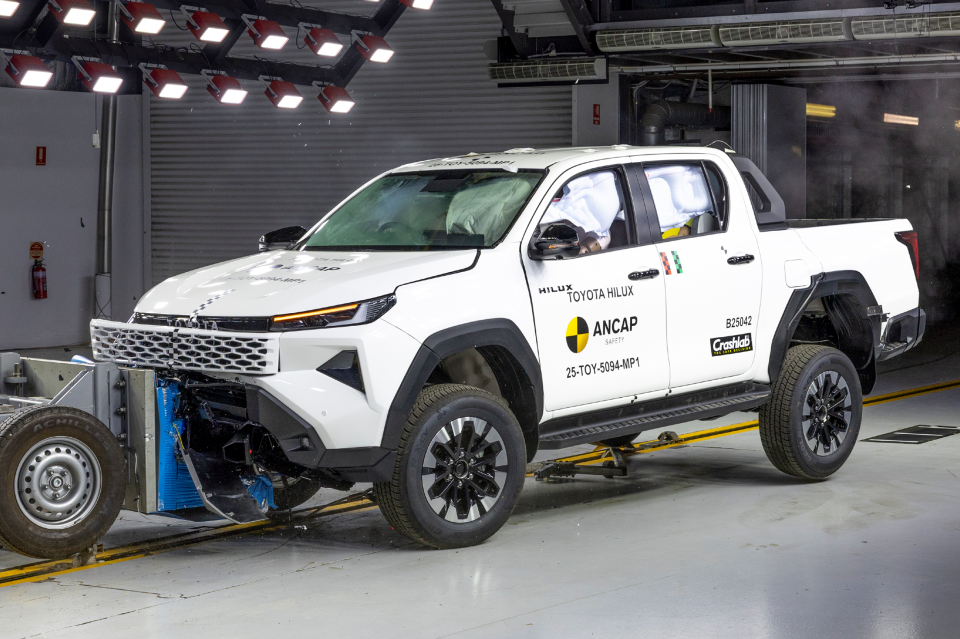
This rating applies to all variants bar the Rugged X, which remains ‘unrated’.
ANCAP says the new-generation ute – which despite fresh styling inside and out, is based on the previous generation – received “consistently Good performance in testing across all four assessment pillars”.
There were some lower ratings given, including for protection of the driver’s neck in the full-width frontal test (Marginal) and their chest in the oblique pole test (Adequate).
It was also dinged with an eight-point penalty (out of a possible eight points) for vehicle-to-vehicle compatibility in the frontal offset test, as its structure presented “a higher risk to occupants of an oncoming vehicle”.
Another popular nameplate, the Mitsubishi ASX, was also assessed by ANCAP. However, there was no local crash testing performed of the second-generation ASX, which is a rebadged Renault Captur.
ANCAP therefore based its safety rating on Euro NCAP testing of the Captur and Symbioz conducted in Europe in 2024, with Mitsubishi providing the safety authority with technical information and additional test data to show the Renaults’ results could also be applied to the ASX.
The ASX received an adult occupant protection rating of 76 per cent, a child occupant protection rating of 83 per cent, a vulnerable road user protection rating of 76 per cent, and a safety assist rating of 70 per cent.
ANCAP notes its adult occupant protection was constrained by a Weak rating for driver chest protection in the frontal offset crash test, as well as the absence of a front centre airbag which can help limit contact between the heads of front-seat occupants in side impacts.
This resulted in the ASX missing out on a five-star rating.
The ASX is far from alone among small SUVs in receiving a rating of less than five stars, however, with the top-selling Hyundai Kona and MG ZS also wearing a four-star rating.
ANCAP said the ASX’s rating “should be noted by fleet purchasers and consumers as a departure from the popular vehicle’s previous rating”. The last ASX had a five-star rating, but this was based on less stringent testing procedures in effect during its 2014 testing. This rating also expired in 2022.
The second-generation Hyundai Palisade received a five-star safety rating, scoring full points for child occupant protection in frontal and side impact crash tests, and full points for adult protection in side impact and oblique pole tests.
It received an adult occupant protection rating of 84 per cent, a child occupant protection rating of 86 per cent, a vulnerable road user protection rating of 71 per cent, and a safety assist rating of 73 per cent.
This rating applies to both seven- and eight-seat Palisade variants.
ANCAP noted the Palisade received a penalty for a loss of footwell integrity in the frontal offset test, with a small opening found in the seam between panels in the footwell.
It also noted Hyundai “did not provide sufficient data for the vehicle-to-vehicle impact scenario, so this has not been assessed or rewarded”.
The Denza B5, one of the two debut models from BYD’s premium brand, received a five-star rating.
It received an adult occupant protection rating of 86 per cent, a child occupant protection rating of 95 per cent, a vulnerable road user protection rating of 74 per cent, and a safety assist rating of 78 per cent.
While crash protection was strong, ANCAP did record an Adequate rating for driver chest protection in the frontal offset test and Marginal protection in the oblique pole test.
ANCAP also praised the B5 for its direct child presence detection system, which provides an alert and warning when a child may have been left in the vehicle and even intervenes by activating the air-conditioning if the driver doesn’t respond to the initial warning.
Finally, the GAC Aion V received a score of five stars, with an adult occupant protection rating of 88 per cent, a child occupant protection rating of 87 per cent, a vulnerable road user protection rating of 79 per cent, and a safety assist rating of 79 per cent.
“The vehicle performed strongly in side-impact and far-side performance, positioning the Aion V among some of Australia’s top safety performers,” said ANCAP in its press release.
While ANCAP noted the fitment of a child presence detection, it said it didn’t meet its requirements and its inclusion therefore wasn’t rewarded.
The Aion V is the first of GAC’s three debut models on sale here to receive an ANCAP rating, with the Emzoom small SUV and M8 people mover yet to be assessed.
This latest round of testing was conducted ahead of revised assessment criteria coming into effect from January 1, 2026.
Key changes will see a focus on intrusive driver assist technology and cars without physical buttons, and there will be four new pillars for testing: safe driving, crash avoidance, crash protection and post-crash, all of which have a total of 100 points.
MORE: New ANCAP safety assessment will target annoying tech, EVs and triple-zero calls
MORE: Everything Toyota HiLux • Mitsubishi ASX • Hyundai Palisade • Denza B5 • GAC Aion V