


Large seven-seat SUVs are common among luxury brands, but in the electric vehicle (EV) space they’re much rarer.
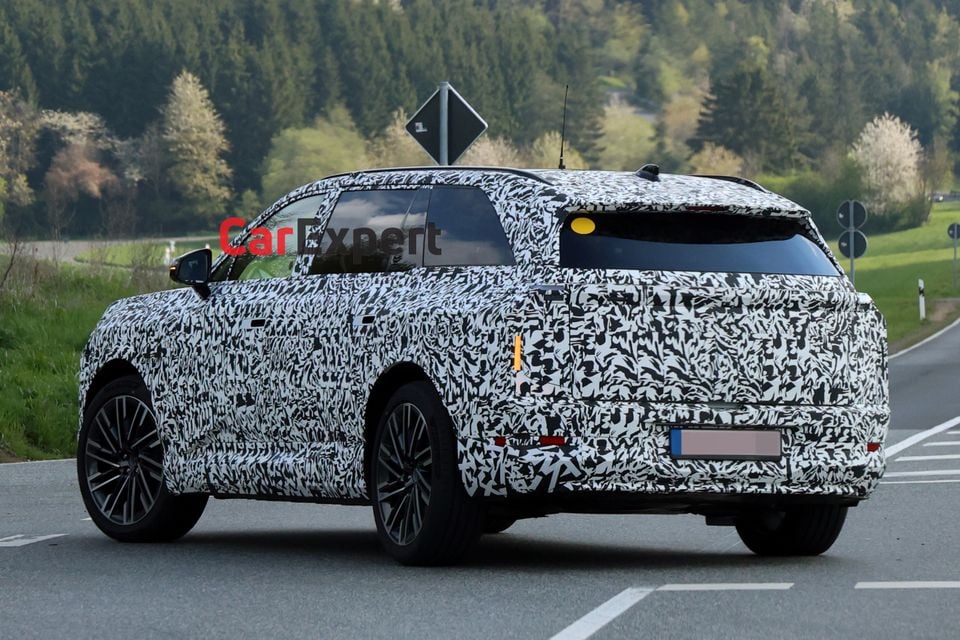
Lexus has been spied testing a new SUV, which is expected to wear the TZ nameplate, and to take on rivals like the Cadillac Vistiq and Volvo EX90 – but thus far nothing from brands such as Audi, BMW or Porsche.
Toyota revealed the Lexus Electrified SUV and Toyota bZ Large SUV concepts in 2021, with the two SUVs appearing to share the same body but featuring different front- and rear-end styling.
CarExpert can save you thousands on a new car. Click here to get a great deal.
The Toyota concept begat the electric Highlander six/seven-seat SUV revealed earlier this year, which received little in the way of changes in the transition to production vehicle.
Now, Lexus has been spied testing a large SUV at the Nürburgring, and through the camouflage we can see it closely resembles the Lexus Electrified SUV concept.
It’s unclear how much the production Lexus will ultimately end up resembling the Toyota Highlander.

Lexus’ current flagship crossover SUV is the hybrid and plug-in hybrid TX, produced only in left-hand drive, which closely resembles the related (and also LHD-only) Toyota Grand Highlander.
Toyota’s premium brand trademarked the TZ450e and TZ550e nameplates in 2023, which ties in neatly with the existing RZ electric SUV and the combustion-powered RX and TX.
Japanese website Best Car Web has also reported an “electric version” of the TX will be launched in Japan this year, which could mean a right-hand drive version of the new Lexus large SUV will eventuate. While Japan is a right-hand drive market, new left-hand drive vehicles can be sold there, though the report notes the new Lexus will be produced in Japan, which almost certainly means right-hand drive production.
The US-built Toyota Highlander EV and its Subaru Getaway twin, however, still have yet to be confirmed for right-hand drive.
The outlet reports the Lexus will offer a dual-motor all-wheel drive powertrain and a 74kWh battery, as well as a total length of 5100mm and total width of 1995mm on a 3050mm wheelbase – making it 50mm longer than the Highlander EV and fractionally wider, but using the same wheelbase.
The TZ could borrow its powertrains from the smaller Lexus RZ or the Toyota Highlander EV/Subaru Getaway duo.
The recently updated RZ range is available in Australia in RZ500e and RZ550e variants, with an RZ600e F Sport Performance variant following later in 2026.
The RZ500e features a dual-motor all-wheel drive powertrain outputting 280kW of power and 537Nm of torque, powered by a 74.7kWh battery and offering 460km of WLTP range.
The RZ550e upgrades to a 77kWh battery and a 300kW dual-motor powertrain, though range drops to 437km. The RZ600e pumps out 313kW.
The Highlander EV, in contrast, is available in 165kW/269Nm single-motor front-wheel drive and 252kW/438Nm dual-motor all-wheel drive variants, with a standard 77kWh battery offering a claimed range of 462km and 434km respectively. Toyota will also offer the Highlander EV with a larger 95.8kWh battery, good for 415km of range.
Should the flagship electric Lexus SUV be offered in Australia, it’s unclear how much it would cost here.
The Cadillac Vistiq will be launched this year in a single, loaded Platinum trim with six seats and a price tag of $116,000 before on-road costs, while the seven-seat Volvo EX90 range opens at $124,990 before on-road costs.