


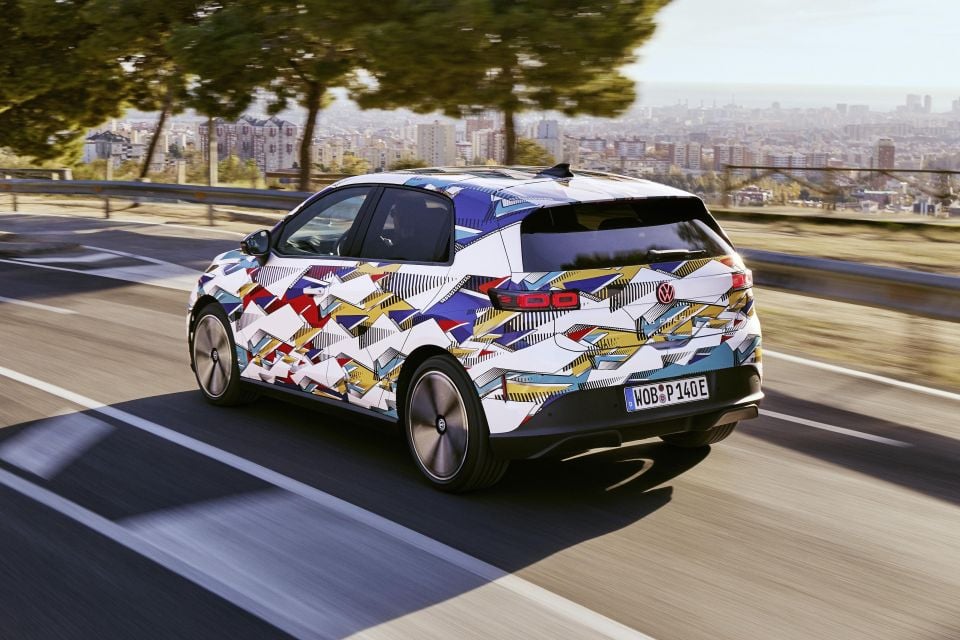
Volkswagen has detailed its first electric Polo, ahead of its European debut in 2026.
The Volkswagen ID. Polo, which has yet to be confirmed for Australia, will be offered with a range of power outputs and batteries.
All ID. Polos will be based on the MEB+ platform, intended for smaller, more efficient and more affordable vehicles, and feature a single-motor front-wheel drive configuration.
A 37kWh lithium iron phosphate battery will be offered with either 85kW or 99kW electric motors, supporting DC fast-charging at up to 90kW.
CarExpert can save you thousands on a new car. Click here to get a great deal.
A larger 52kWh nickel manganese cobalt battery will be offered with a 155kW electric motor, with the flagship GTI to use this battery and a 166kW electric motor. This larger battery has a 130kW maximum DC charge rate, and a range of up to 450km on the WLTP cycle.
Here’s how the ID. Polo compares size-wise with the existing Polo:
| ID. Polo | Polo | |
|---|---|---|
| Length | 4053mm | 4080mm |
| Width | 1816mm | 1751mm |
| Height | 1530mm | 1450mm |
| Wheelbase | 2600mm | 2564mm |
| Boot space (seats up) | 435L | 351L |
| Boot space (rear seats folded) | 1243L | 1125L |
Volkswagen notes interior width and headroom measurements are greater in the ID. Polo.
The use of the MEB+ architecture also allows the ID. Polo to be fitted with next-generation active safety and driver assist technology.

It’ll be offered with “significantly enhanced” Travel Assist, enabling motorway lane changes and traffic light and stop sign recognition.
ID. Polo pricing will start at €25,000 (~A$44,000) in Europe, which is around €5000 (~A$8800) more than the most affordable petrol Polo.
Previewed by the 2023 ID. 2all and ID. GTI concepts and debuting the German auto brand’s new Pure Positive design language, the ID. Polo represents a move away from unfamiliar alphanumeric ID nameplates and blobby designs.
Development of the ID. Polo was led by Seat and Cupra and will be built by the Spanish brands in Martorell, Spain, though it was designed at the Volkswagen Design Centre in Wolfsburg.
It’s one of six new electric models from Volkswagen due in 2026.
The Polo nameplate has now been used continuously by Volkswagen for just over 50 years.
An updated version of the existing combustion-powered Polo will be sold alongside the new ID. Polo, enabled by a watering down of Europe’s upcoming emissions standards.
“There will be an update to the combustion Polo. We can continue to build combustion-powered cars for as long as we need to, there is no limit. The existing [MQB-A0] platform is more than capable of that,” Volkswagen’s board member for sales, marketing and aftersales, Martin Sander, told Auto Express.
The MQB-A0 platform, also used by the likes of the Skoda Fabia and Kamiq and Volkswagen T-Cross, is a simplified version of the Golf’s MQB chassis with simpler rear suspension that’s cheaper to produce.
Mr Sander said it’s “a big job” and “expensive” to update the Polo to include upgraded active safety and driver assist technology and mild-hybrid and hybrid powertrains, as well as higher-quality materials and fresh styling inside and out, but “we need to do it”.
“In order to compete in Europe, we have to service the whole of Europe. Norway is 100 per cent electric, but the south is very different,” explained Mr Sander.
“And we still need to offer our customers the sorts of car they want to buy, no matter their region or preference.”