


Ferrari has outlined the full technical package for its first electric vehicle (EV), currently codenamed the Ferrari Elettrica, confirming a big 122kWh battery, an expected output exceeding 700kW, and a range of more than 530km.
The car represents a major step for the Maranello brand, bringing full battery-electric propulsion into the Italian automaker’s lineup for the first time.
The finished model’s name is yet to be confirmed ahead of next year’s unveiling, but it being referred to as the Elettrica by Ferrari both internally and externally for now. It will have four practical seats and, although it is yet to be confirmed, we believe it will have four doors as well.
CarExpert can save you thousands on a new car. Clickhereto get a great deal.
Revealed during Ferrari’sTechnology and Innovation Workshop, the project has been under development since 2020. It was designed to maintain the precision, feedback and emotion of the company’s combustion- and hybrid-powered models while meeting future emissions and efficiency goals.
The first Ferrari EV will be assembled in the company’snew e-Buildingin Maranello, a facility dedicated to hybrid and electric vehicle production lines.
Power comes from two Ferrari-developed e-axles – one up front and one at the rear – delivering a combined output exceeding 1000cv (735kW) of power in boost mode. The front axle generates a claimed 210kW and 3500Nm of torque at the wheels, while the rear produces 620kW and 8000 Nm.
Both feature compact, high-speed permanent-magnet motors withHalbach-array rotorsderived from Formula 1 technology. Ferrari quotes efficiency of up to 93 per cent, with motor speeds reaching 30,000rpm at the front and 25,500rpm at the rear.

Performance targets include a 0-100 km/h time of 2.5 seconds, a top speed of 310km/h, and a WLTP range exceeding 530km. The Elettrica incorporates an800-volt electrical architectureand uses silicon-carbide power modules for its inverters, designed and built entirely in-house. Each axle operates as a self-contained system with dedicated cooling and lubrication.
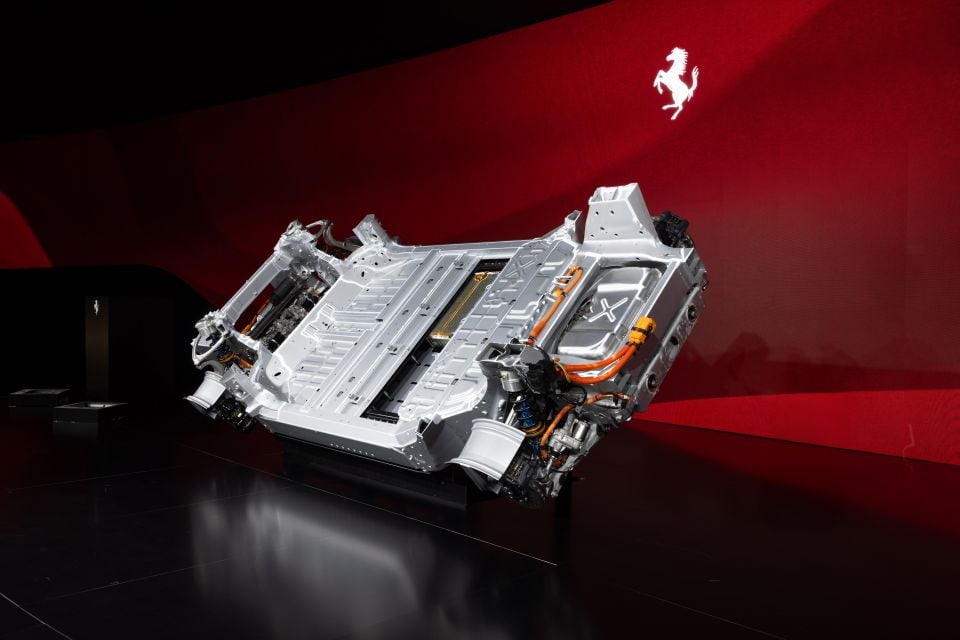
At the centre of the platform is a122 kWh structural battery pack, designed and assembled in Maranello with cells supplied by South Korean battery manufacturerSK On. The battery contains 210 cells arranged in 15 replaceable modules, allowing individual components to be serviced or replaced under Ferrari’sForeverprogram, which guarantees long-term maintenance and support for electrified models.
The pack achieves195Wh/kg at pack leveland305Wh/kg at cell level, operating at 800 volts with peak current of 1200 amps. It supports350kW DC fast-chargingand Ferrari’s engineers say it tookfour years to develop, making it one of the company’s most complex in-house components. The structural design bolts the pack to the chassis at 20 points, increasing rigidity and lowering the centre of gravity by around 80mm compared with a comparable V8 model.
Cooling channels are integrated directly into the aluminium shell for temperature uniformity and impact resistance. The battery’s mass is concentrated beneath the cabin floor, helping achieve a47-53 front-rear weight balanceand a total weight of around2300kg.
Ferrari’s proprietaryBattery Management SystemandCell Supervisory Controllersoversee safety and energy flow, communicating across a high-speed CAN network. The company claims full in-house control over all power electronics, algorithms and operating software.
The Elettrica’s chassis and body use75 per cent recycled aluminium, reducing production emissions by approximately6.7 tonnes of CO2per vehicle. The car also debuts Ferrari’sthird-generation 48-volt active suspension system, allowing independent adjustment at each wheel to enhance body control and ride comfort.
In typical Ferrari fashion, the Elettrica incorporates an unconventional approach to sound. Instead of artificial audio, a high-sensitivity accelerometer mounted to the inverter casing captures natural vibrations from the powertrain, which are then amplified through the car’s structure – creating an evolving tone that Ferrari describes as “the direct and authentic expression of its components”.
The driving interface includes a right-hand paddle for selecting five levels of torque delivery, which ensures smooth, continuous acceleration. The left-hand paddle controls regenerative braking intensity. TheManettinoswitch governs chassis settings, while a neweManettinosystem manages the car’s Range, Tour, and Performance drive modes.
Tyres have been co-developed with three suppliers to reduce rolling resistance by 15 per cent without compromising grip. The Elettrica’s 47/53 weight distribution and low centre of gravity are designed to maintain Ferrari’s traditional handling balance, despite the increase in overall weight.
Sustainability and longevity are central to the design. The car’s modular battery layout, coupled with Ferrari’s new e-Building manufacturing line and theFerrari Foreverlifetime maintenance initiative, means every Elettrica can be kept serviceable indefinitely. The program already supports Ferrari’s hybrid models, offering guaranteed parts availability and certified service for as long as the car exists.
Ferrari CEOBenedetto Vignasaid the Elettrica was conceived not as a replacement for combustion models, but as an expansion of the brand’s capabilities.
“We are mastering different technologies to create different driving thrills,” he said. “The objective of our company is to harness any technology to delight our clients.”
Chief Product Development OfficerGianmaria Fulgenziadded that the car had been developed to preserve Ferrari’s hallmark response and control characteristics.
“It is an electric car, but first and foremost, conceptually and in practice, it is a Ferrari,” he said. “The Elettrica will deliver new experiences without losing what makes our cars unique.”
Design has been led byLoveFrom, the creative firm founded by former Apple designerJony Iveand Marc Newson. Mr Vigna described the collaboration as an example of Ferrari’s “open innovation” philosophy.
“We are a company where open innovation is fundamental,” he said. “If you want to challenge yourself, you have to work with people that see reality with different eyes.”
Ferrari Elettrica: Technical specifications
| Category | Specification |
|---|---|
| Powertrain | Dual e-axles with four independent motors (2 front, 2 rear) |
| Total output | >1000cv (735kW) in boost mode |
| Front motor output | 210kW / 3500Nm at wheels, up to 30,000rpm |
| Rear motor output | 620kW / 8000Nm at wheels, up to 25,500rpm |
| Motor efficiency | Up to 93% |
| Battery type | Structural lithium-ion, integrated into chassis |
| Battery capacity | 122kWh (gross) |
| Cell supplier | SK On (South Korea) |
| Cell configuration | 210 cells across 15 replaceable modules |
| Voltage architecture | 800V (880V max) |
| Energy density | 195Wh/kg (pack), 305Wh/kg (cell) |
| Peak current | 1200 amps |
| Charging (DC) | 350kW |
| Charging (AC) | 22kW |
| Range (WLTP est.) | >530km |
| Acceleration (0–100km/h) | 2.5 seconds |
| Top speed | 310km/h |
| Weight | ≈2300 kg |
| Weight distribution | 47% front / 53% rear |
| Wheelbase | 2960 mm |
| Chassis | Aluminium, 75% recycled content |
| CO2 saving in production | 6.7 tonnes per car |
| Suspension | 3rd-generation 48V active suspension system |
| Drive modes | Range, Tour, Performance |
| Torque control | 5 selectable torque levels via steering paddle |
| Regenerative braking | Adjustable via left paddle |
| Acoustic system | Real vibration resonance amplified through chassis |
| Manufacturing facility | e-Building, Maranello (Italy) |
| Development time | 4 years |
| Reveal | Q2 2026 (production to follow) |
Battery and technology comparison
Ferrari quotes a battery pack energy density of195Wh/kg, which ranks among the highest for a structural, high-performance battery.
Publicly available data suggests a few other manufacturers have announced higher theoretical figures, although most are yet to be verified in production vehicles.
Even so, Ferrari’s specification remains highly competitive given the pack’s dual role as both energy source and structural component.
| Model | Battery Type | Pack Energy Density | Cell Energy Density | Pack Capacity | Notes |
|---|---|---|---|---|---|
| Ferrari Elettrica | SK On NMC, structural | 195Wh/kg | 305Wh/kg | 122kWh | 15 replaceable modules, in-house design |
| NIO ET7 150kWh | WeLion semi-solid-state | ~260Wh/kg | ~360Wh/kg | 150kWh | Limited production, highest current figure |
| Zeekr 001 (CATL Qilin) | NMC 3.0 | ~200Wh/kg | ~255Wh/kg | 140kWh | Advanced volumetric efficiency |
| Rimac Nevera | High-performance NMC | ~165–170Wh/kg | n/a | 120kWh | Focus on peak power, not range |
| Tesla Model Y (4680 pack) | Structural NCA | ~161–182Wh/kg | ~272–296Wh/kg | 82kWh | Mass-production benchmark |
On these metrics, Ferrari’s pack sits close to the very top of the industry range. It trails NIO and CATL’s latest (and yet to be real-world tested) technology in terms of energy density, but outperforms most Western supercar applications, including Rimac and Tesla’s structural systems.
For deeper coverage of Ferrari’s electric transformation, see CarExpert’s related reports: