


What’s goin’ awwwwn, Tayron?
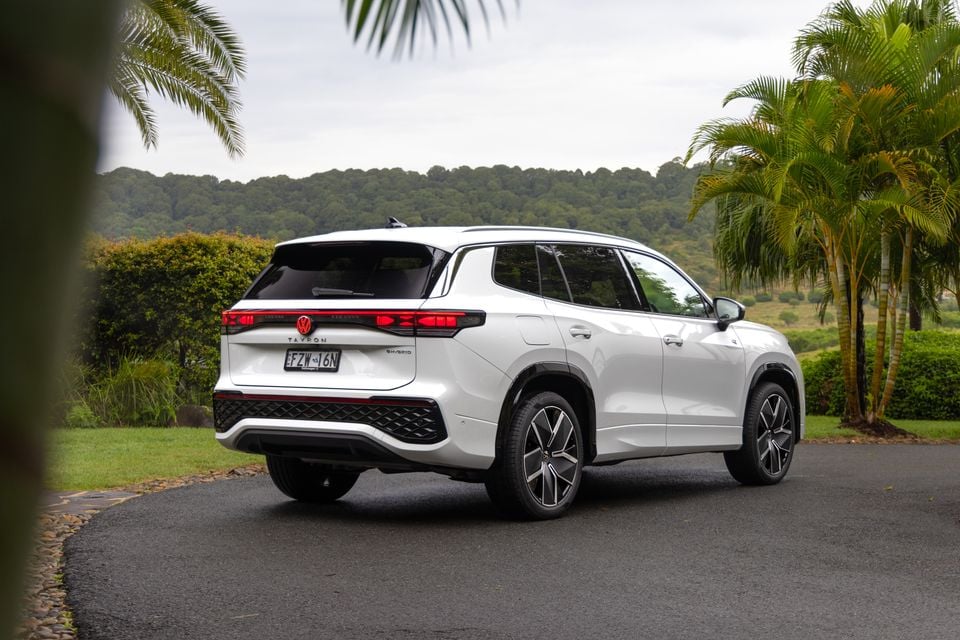
The Volkswagen Tayron (nee Tiguan Allspace) is adding plug-in hybrid (PHEV) power – meet the 2026 Volkswagen Tayron eHybrid, available in two flavours.
Like the smaller Tiguan mid-size SUV, which also adds two PHEV variants this year, the Tayron eHybrid boasts over 100km of EV driving range while offering even more rear-seat space and luggage capacity than its smaller stablemate.
Sadly, there’s no third row of seats available in either plug-in Tayron, due to the placement of the battery pack under the boot floor. The Tayron PHEV does, however, significantly undercut the related Skoda Kodiaq PHEV at base level, by some $7000.
Not only is it cheaper than the similarly sized Kodiaq, it’s also cheaper at base level than the smaller Tiguan eHybrid in Australia – though the technicality is that the Tiguan has the contents of the Tayron’s optional Sound & Vision Package as standard in base specification.

Still, if outright space and metal-for-your-money is your priority, the Tayron could be your pick of VW’s new plug-in SUVs, especially since larger PHEV SUVs aren’t all that common, particularly at the base grade’s launch offer price point.
Should you get it on with the plug-in Tayron? We joined the Australian media drive in Byron Bay to find out.
Note: This review will focus on the 150TSI eHybrid Elegance, but the 200TSI eHybrid R-Line is pictured throughout
How much does the Volkswagen Tayron cost?
The Tayron eHybrid range starts at $62,390 plus on-road costs for the 150TSI Elegance specification, but until June 30 you can actually own it for $61,990 drive-away.
| Model | Price before on-road costs | Drive-away pricing – Until 30 June |
|---|---|---|
2026 Volkswagen Tayron 110TSI Life | $48,950 | $49,990 |
2026 Volkswagen Tayron 150TSI Life 4Motion | $54,790 | $54,990 |
2026 Volkswagen Tayron 150TSI Elegance 4Motion | $60,390 | – |
2026 Volkswagen Tayron 150TSI eHybrid Elegance | $62,390 | $61,990 |
2026 Volkswagen Tayron 195TSI R-Line 4Motion | $74,550 | – |
2026 Volkswagen Tayron 200TSI eHybrid | $76,550 | $75,990 |
As noted earlier, that’s less than the smaller Tiguan 150TSI eHybrid Elegance, though if you add the Tayron’s optional Sound & Vision Package ($4200), that $2000 advantage quickly becomes a $2200 deficit based on the drive-away pricing offer at launch.
Find your perfect new car with CarExpert
Perhaps the most prominent rival in the market currently is the BYD Sealion 8, which starts at $56,990 plus ORCs and trumps the Tayron eHybrid by offering a PHEV drivetrain with three rows of seating.
To see how the Volkswagen Tayron lines up against the competition, check out our comparison tool
What is the Volkswagen Tayron like on the inside?
It’s basically a Tiguan, just longer.
No fiddly touch-capacitive buttons on the steering wheel is a highlight, as is the smart dial on the centre tunnel that can be configured to toggle different functions. It can also light up in different colours based on the selected ambient lighting.
The massive (optional) 15-inch touchscreen infotainment system looks a little tacked on and won’t suit all tastes, but it’s running the latest version of Volkswagen’s software interface, meaning a dedicated (virtual) toolbar for climate controls, snappier load times than the infotainment system that debuted in the pre-update Mk8Golfhatchback, and a simplified menu structure.
Sadly, VW Australia still doesn’t offer proprietary connected services ex-factory, but does have a third-party solution via the GoConnect smartphone app, which offers decent baseline functionality like vehicle status and being able to schedule services with your local dealer.
One thing to note as a difference between the Tayron and Tiguan up front, other than the name of each model being stamped across the dashboard, is that the Elegance-spec Tayron gets a wood-effect trim insert that stretches the width of the dash – make of that what you will.
Also unlike the smaller Tiguan in Elegance trim, the Tayron eHybrid requires ticking an option box ($4200) to add items like Harman Kardon premium audio, a head-up display, ‘IQ.Light’ HD Matrix LED headlights, as well as upping screen size from 12.9 inches to 15.
Given the additions I think it’s a worthy box to tick, and it brings the price to just over $65,000 drive-away when you account for the launch drive-away offer which ends on June 30.
Material quality is pretty good too, with more soft-touch surfaces and stitched leather-look detailing than in the old Tiguan Allspace. As many premium brands continue to lower their standard of fit and finish, as well as some of the Tayron’s mainstream-branded rivals, VW is heading in the right direction here.
Still, I’m not sure about how I feel about the bold gloss-black dash insert that sits behind the touchscreen and incorporates the driver’s display. Combined with the etched ambient lighting cutouts, it’s a little naff and looks too much like VW is trying to ape the Chinese brands – just my opinion.
Little differentiates the Tayron eHybrid from petrol-powered versions, though the 10.25-inch Digital Cockpit Pro instrument cluster has a power meter that combines with the digital tachometer, as well as additional symbols and widgets that go with the electrified underpinnings.
You can also toggle a charge status meter in the infotainment system, as well as an animated energy flow graphic if that’s your thing.
Also worth noting are the excellent front seats, which wear ‘ergoActive’ branding in Elegance spec, and feature 12-way power adjustment, three-position memory function, as well as three-stage heating and ventilation in addition to a pneumatic massage function.
Storage remains a strong point, with plenty of nooks and crannies to stow your belongings in. Of particular note are the huge, flock-lined door bins, which put the ones in my Golf to shame. The cubby under the centre console, complete with wireless phone charger, is also a nice touch.
The Tayron adds 110mm to the Tiguan’s wheelbase, and 253mm of added overall length, as well as more boot space which we’ll get to later.
But that all means in simple terms that the second row of the Tayron is nigh on capacious, with heaps of leg, knee and toe room, even for taller passengers like me at 6’1″.
Clever touches include manual sunshades in the rear windows to block out haters, a third zone of climate control, a sliding and reclining second-row bench, map pockets on the front seatbacks, and big lined door pockets with space for larger bottles.
The driveline hump in the floor will eat into the foot space of the centre passenger, but the footwells on either side are pretty deep and wide. You can also fold down the rear seatbacks in 40:20:40 format, so if you need to stow a longer item you can still seat four adults in comfort.
The Tayron eHybrid doesn’t offer a third row of seats due to the battery being placed under the rear floor, but it still has a massive 705 litres of capacity with the second row in use – though that’s with the seats in their forward position.
Drop the second-row seatbacks and you have a massive 1915L on hand, but the seats-up figure is 145L less than non-eHybrid versions of the Tayron. PHEV vehicles also switch out a space-saver spare for a tyre mobility kit.
| Dimensions | Volkswagen Tayron eHybrid |
|---|---|
| Length | 4792mm |
| Width | 1866mm |
| Height | 1674-1677mm |
| Wheelbase | 2791mm |
| Cargo capacity | 705-1915L |
To see how the Volkswagen Tayron lines up against the competition, check out our comparison tool
What’s under the bonnet?
All Tayron eHybrids employ a turbocharged 1.5-litre ‘TSI’ four-cylinder petrol engine teamed with an electric motor, lithium-ion battery pack, and a six-speed ‘DSG’ dual-clutch automatic transmission driving the front wheels only.
Specifications | Tayron 150TSI eHybrid | Tayron 200TSI eHybrid |
|---|---|---|
Engine | 1.5 4cyl turbo-petrol | 1.5 4cyl turbo-petrol |
Engine outputs | 110kW + 250Nm | 130kW + 250Nm |
Electric motor outputs | 85kW + 330Nm | 85kW + 330Nm |
System outputs | 150kW + 350Nm | 200kW + 400Nm |
Battery | 19.7kWh li-ion | 19.7kWh li-ion |
Transmission | 6-speed DSG | 6-speed DSG |
Drive type | FWD | FWD |
Weight | 1928kg – Tare | 1932kg – Tare |
0-100km/h (claimed) | 8.6 seconds | 7.3 seconds |
Fuel economy (claimed) | 1.7L/100km | 1.8L/100km |
Fuel economy (as tested) | 0.0L/100km | – |
Energy consumption (claimed) | 13.8kWh/100km | 14.1kWh/100km |
Energy consumption (as tested) | 18.0kWh/100km | – |
Electric driving range | 116km | 113km |
Fuel tank capacity | 45L | 45L |
Fuel requirement | 95-octane premium unleaded | 95-octane premium unleaded |
CO2 emissions | 37g/km | 38g/km |
Emissions standard | Euro 6 | Euro 6 |
Braked towing capacity | 1800kg | 2000kg |
Our real-world fuel consumption figure was achieved on a circa-50km mixed drive loop in EV mode with a battery starting at roughly 50 per cent charge.
We originally intended to follow up with a drive of the 200TSI eHybrid R-Line the next day, but logistical changes prevented us from testing the up-spec version.
To see how the Volkswagen Tayron lines up against the competition, check out our comparison tool
How does the Volkswagen Tayron drive?
I did a pretty extensive drive loop through the winding B-roads surrounding Byron Bay in just EV mode, but can lean on my time with the smaller Tiguan eHybrid to fill in some gaps.
We managed to do a ~50km loop in the Tayron 150TSI eHybrid Elegance in just E-Mode with a half-charged battery, resulting in an indicated fuel consumption figure of 0.0L/100km, and an energy consumption readout of 18.0kWh/100km.
The Tayron PHEV will default to ‘E-Mode’ on startup with sufficient charge in the battery, prioritising electric power to minimise fuel use and emissions. You can flick it into hybrid to have the petrol engine assist earlier on in the acceleration response, and preserve charge.
The 85kW/330Nm electric motor doesn’t sound all that powerful on paper, but it offers the sort of outputs that not long ago would have been quoted by a smaller diesel engine in a car like this.
As such, the immediacy of torque response and linearity of the e-motor’s power delivery makes for smooth and quiet progress, even if you can occasionally feel the DSG shifting as you roll along.
The added wheelbase and length of the Tayron makes it feel a little more planted and settled on the road than the shorter Tiguan, and its larger size means you’re not tempted to really fang it about, but rather make smooth and measured progress.
As such, the eHybrid drivetrain makes a lot of sense here. It’s smooth, comfortable and quiet, getting you and your family (and whoever else) to where you need to go with lower fuel consumption and emissions than other Tayrons with purely petrol powertrains.
It feels a touch off the Tiguan’s pace with the same powertrain, noting the Tayron’s extra size and about 50kg of extra heft, but again you shouldn’t feel the need to wring its neck.
While we didn’t give the Tayron a proper go in Hybrid mode due to time constraints, our time with the Tiguan eHybrid tells us the 150kW PHEV system has more than enough go to get this family bus moving at a decent clip, and will feel more powerful on the roll than the 8.6-second 0-100km/h claim might suggest.
Standard adaptive damping with 15 stages of adjustment is pretty high-tech for the segment, meaning that beyond the standard Eco, Comfort and Sport settings you can go softer than Comfort and harder than Sport.
Given the wide variance of Australia’s road network, particularly in areas like where we drove in and around Byron Bay, the standard settings are a good middle ground to tackle most conditions.
Said modes also adjust steering and throttle response to the driver’s liking, and can also be individually configured if you wish. I found Comfort to be best, with any extra urgency requiring a quick flick of the column-mounted shifter from D to S.
Whether you’re tootling around town or humming along the highway, the Tayron PHEV in electric mode does a great job of isolating occupants from road imperfections and the sounds of the outside world, with minimal wind noise and tyre roar permeating the cabin, even on rougher black top.
From expert reviews to the right deal
CarExpert brings together reviews, research tools and trusted buying support, guiding you from research to delivery with confidence.
The steering and ride in the Elegance is quite clearly focused on everyday comfort and manoeuvrability, with very light steering and a supple ride especially in Comfort mode.
Even in Sport mode it’s far from harsh or uncomfortable, and in the more aggressive setting the steering adds weight for more engagement. However, the latter feels artificial and doesn’t really add any extra feel, even if the steering response is pretty quick and accurate in general.
While not necessarily a standout for athleticism or engagement, the Tayron’s on-road manners are definitely in line with VW’s ‘premium for the people’ schtick, offering a more upmarket and refined feel behind the wheel than a lot of electrified offerings at a similar price point. It’s an excellent all-rounder, complemented by achievable real-world efficiency.
It’s perhaps a more profound point when you consider similarly sized hybrid and PHEV rivals charge considerably more for similar levels of specification and less competitive electrified driving capability. For under $65,000 you’ll only get low- to mid- grade versions of the Hyundai Santa Fe Hybrid (from $57,650), for example, while the Kia Sorento PHEV starts from $71,175 – though both electrified Korean rivals offer three rows of seating.
The Mitsubishi Outlander PHEV Aspire boasts AWD, seven seats and more on-paper grunt than the Volkswagen, but is likewise dearer ($66,790) and has less standard luxury and tech items than the Volkswagen.
Beyond general on-road behaviour and the performance of their plug-in powertrains, the eHybrids retain the same excellent driver assist tech calibration as the wider Tayron range.
VW’s Travel Assist system remains one of the better semi-autonomous highway assistants in the business, with adaptive cruise control and lane-centring functions working predictably, accurately and intuitively.
The blind-spot monitoring and rear cross-traffic alert systems also do what they say on the tin, and the audible speed limit assistant has a faint and peaceful chime rather than the incessant and annoying bongs presented by many rival brands and models.
The Tayron eHybrid range also comes standard with Area View surround cameras as well as front and rear sensors to make parking this SUV a little bit easier, and there’s even a Park Assist Plus function which can semi-autonomously slot the big SUV into both perpendicular and parallel spaces.
To see how the Volkswagen Tayron lines up against the competition, check out our comparison tool
What do you get?
The VW Tayron eHybrid is available in two specifications in Australia – Elegance and R-Line.
2026 Volkswagen Tayron 150TSI eHybrid Elegance equipment highlights:
- 19-inch alloy wheels
- Adaptive Chassis Control Pro – 15-stage damping
- Electrically operated tailgate
- Keyless access with alarm
- Digital Cockpit Pro – 10.25-inch cluster
- 12.9-inch Discover touchscreen navigation
- Wireless App-Connect – Apple CarPlay, Android Auto
- 2 x wireless phone chargers
- Leather-appointed upholstery
- ErgoActive comfort sport front seats
- Electrically adjustable front seats incl. memory function
- Heated, ventilated front seats incl. massage function
- Heated outboard rear seats
- Heated steering wheel
- Rear privacy glass
- LED Plus headlights
- Rear window sunblinds – manual
- Luggage partition net
2026 Volkswagen Tayron 200TSI eHybrid R-Line adds:
- 20-inch alloy wheels
- R-Line exterior, interior styling
- 15-inch Discover Pro Max touchscreen navigation
- Harman Kardon premium audio
- Head-up display
- IQ.Light HD Matrix LED headlights incl. Dynamic Light Assist
Options
Each Tayron eHybrid is available with an option package, as well as a handful of single-item optional extras.
Sound & Vision Package – Elegance: $4200
- 15-inch Discover Pro Max navigation system
- 700W Harman Kardon premium audio
- Head-up display
- IQ.Light HD Matrix LED headlights
- Dynamic Light Assist – Adaptive high-beam
Black Style Package – R-Line: $1500
- 20-inch ‘York’ alloy wheels
- Interior styling in Black/Dark Anodized trim
- Gloss black exterior mirror housings
- Gloss black exterior accents
Standalone options include:
- Metallic paint: $800
- Premium metallic paint: $1200
- Panoramic sunroof: $2100
To see how the Volkswagen Tayron lines up against the competition, check out our comparison tool
Is the Volkswagen Tayron safe?
The Volkswagen Tayron has a five-star ANCAP safety rating based on testing conducted by Euro NCAP in 2025 – and it applies to all variants including the eHybrid PHEVs.
Category | Volkswagen Tayron |
|---|---|
Adult occupant protection | 87 per cent |
Child occupant protection | 87 per cent |
Vulnerable road user protection | 83 per cent |
Safety assist | 85 per cent |
Standard safety features include:
- 9 airbags, incl:
- Curtain
- Front-centre
- Rear-side
- Adaptive cruise control with stop/go
- Autonomous emergency braking
- Cyclist detection
- Pedestrian detection
- Driver attention monitor
- Front and rear parking sensors
- Front cross-traffic alert
- Junction assist
- Lane departure warning
- Park Assist Plus
- Rear cross-traffic alert
- Safe exit assist
- Surround-view camera
- Traffic sign recognition
- Travel Assist
- Adaptive cruise control
- Lane-centring
- Tyre pressure monitoring
To see how the Volkswagen Tayron lines up against the competition, check out our comparison tool
How much does the Volkswagen Tayron cost to run?
The Tayron eHybrid is subject to the same five-year, unlimited-kilometre new-vehicle warranty as the wider Volkswagen range, with separate high-voltage battery coverage that matches that of the brand’s EVs.
Servicing and Warranty | Volkswagen Tayron eHybrid |
|---|---|
Warranty | 5 years, unlimited kilometres – Vehicle 8 years or 160,000 kilometres – HV battery |
Roadside assistance | 12 months – then service activated |
Service intervals | 12 months or 15,000 kilometres |
Capped-price servicing | Up to 5 years – Care Plan |
Total capped-price service cost | $1605 – 3yr Care Plan $3391 – 5yr Care Plan |
Scheduled maintenance sticks to the same 12-month or 15,000km intervals as the petrol range, and is similar in pricing to its petrol stablemates ($3461).
To see how the Volkswagen Tayron lines up against the competition, check out our comparison tool
CarExpert’s Take on the Volkswagen Tayron eHybrid
The larger of Volkswagen’s pair of new plug-in hybrid SUV offerings perhaps offers stronger value, if not quite as nimble on-road manners.
Electrification (or lack thereof) was a gaping void in the local Tiguan and Tayron lineup, and the new eHybrid PHEVs go a long way to not only addressing that criticism, but their sharp launch pricing also puts VW on solid footing with its new entries.
Relative to the smaller Tiguan, the Tayron offers a lot more space and a more planted ride, which goes a long way provided you don’t need a third row of seating. If you can do without the contents of the Sound & Vision Package, you can actually buy one for less than its smaller sibling, too.
Our indicated real-world efficiency readout also points to a realistic EV range of over 100km per charge, in line with the German brand’s claims, and there’s enough tech and premium touches to compare favourably against the Japanese and Korean competition – but some Chinese rivals offer way more for less.
My advice? The Elegance with Sound & Vision is the best value and all you’ll ever need. Based on my drive of the smaller Tiguan 200TSI eHybrid Elegance, the more powerful Tayron PHEV only offers a negligible amount of extra kit and performance in the real world, which doesn’t feel worthy of spending an additional $10,000.
Interested in buying a Volkswagen Tayron? Let CarExpert find you the best deal here
Click the images for the full gallery