


Hyundai is busy cooking up a new batch of compact performance models… well, slow-cooking.
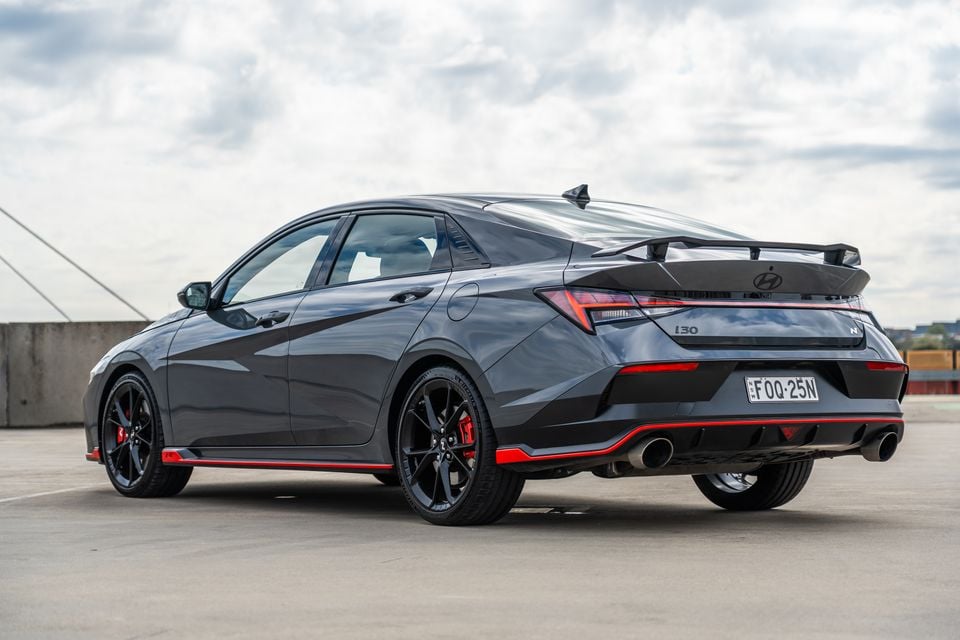
We’ve been talking about successors to the popular i20 N and i30 N for years now, and while their arrival does seem to be inching closer, no launch date has yet been set.
That’ll disappoint impatient enthusiasts, but I understand why Hyundai is taking its time – the currents of electrification are pulling automakers every which way and the i30 Sedan N tested here is a hard act to follow.
First launched in 2021, this spicy saloon wowed from day one with its performance, character and value for money.
Refusing to rest on its laurels, Hyundai updated its smallest N sedan in 2023, introducing a raft of cosmetic and mechanical enhancements to improve an already excellent package.

Since then… not much has changed, bar a warranty extension. Meanwhile, the entry price has risen by $1000, and key rivals including the Subaru WRX and Skoda Octavia RS have received facelifts of their own.
So, does the i30 Sedan N still represent a performance bargain in 2026? Or is it worth waiting for the next melt-in-your-mouth creation out of Namyang? Read on to find out.
How much does the Hyundai i30 Sedan N cost?
Hyundai increased prices across much of its Australian model range by $250 last year, coinciding with a new, longer seven-year warranty, but the i30 Sedan N copped a larger $1000 price hike.
| Model | Price before on-road costs |
|---|---|
2026 Hyundai i30 Sedan N Premium manual | $53,000 |
2026 Hyundai i30 Sedan N Premium auto | $53,000 |
To see how the Hyundai i30 Sedan N lines up against the competition, check out our comparison tool
Let us help you find your new car
Buy your new car without the stress. It’s fast, simple and completely free.
Great service from Travis and team, second time I have used this business would not hesitate to recommend them to anyone
Craig C.
Purchased a Ford Ranger in Sunshine Coast, QLD
CarExpert helped Craig save thousands on his Ford Ranger, now let us save you on your next new car.
What is the Hyundai i30 Sedan N like on the inside?
The cabin is functional and driver-focused, but it’s far from the pinnacle of polish.
We’ve complained about cheap materials for the entirety of the i30 Sedan N’s lifespan, and that gripe persists – hard, scratchy plastics are widespread, while smudge-prone piano black trim is likewise too prevalent.
Some will argue it’s unfair to expect a $53k performance car to feel premium inside, and I tend to agree with them. However, the WRX and Octavia RS present far better, as does the loosely comparable MG 7.
Still, Hyundai has at least spent its seemingly meagre interior budget in the right places. The front seats are not only trimmed in perforated leather, but also heated and ventilated – an unexpected extra that proves worthwhile during spirited summer drives. Further, both chairs are sporty yet comfortable, offering plenty of electric adjustment in addition to pronounced side bolstering for both your ribcage and thighs.
However, all these creature comforts contribute to an unnecessarily high seating position that disrupts the connection between car and driver. Even after dropping the driver’s seat to its lowest possible position, it still felt like I was sitting ‘on’ the car, rather than ‘in’ it. Shorter steerers needn’t worry so much, but it’s a case of try before you buy for six-footers. It’s also worth noting that I don’t remember this being an issue with the basic cloth-trimmed seats in the i30 N hatch.
And we still miss out on the proper lightweight N bucket seats available in Korea, as they’re not compatible with Australian Design Rules (ADRs). Okay, rant over.
Elevated driving position aside, the ergonomics of the i30 Sedan N are otherwise quite good. The steering wheel both tilts and telescopes, and all key cabin controls are within close reach.
In fact, many of those aforementioned controls – including two blue drive mode selectors and the red N Grin Shift button – can be found on the wheel itself, allowing you to configure the driving experience while retaining full control over steering inputs.
Like the seats, the steering wheel is trimmed in perforated leather with Performance Blue stitching, which helps to give the N its own unique identity compared to lesser variants of the i30 Sedan.
This go-fast flagship also features the best technology available across the i30 Sedan range, which isn’t actually high praise.
You get twin 10.25-inch digital displays running older Hyundai software, meaning the graphics are fuzzy and processing power is limited. Again, not the end of the world, but Skoda does this better.
It’s a little harder to forgive the i30 Sedan N’s lack of wireless smartphone mirroring, though. That’s right, you’ll need a USB-A cable to use CarPlay. I mean come on, it’s 2026!
I’m happy for Hyundai to stick with old-school physical climate controls, though. And at least the 2023 update brought a revised wireless charger, USB-C charging outlets, and Bluelink connected services, all of which ensure the technology suite feels somewhat current.
Hyundai’s N Mode app still impresses too, despite its familiarity. Easily found within the infotainment system, this performance hub allows for customisation of just about every aspect of the driving experience. It also displays performance data and maps of popular Australian racetracks, among other functions.
Motorsport nerds will undoubtedly be drawn to these features, and few competitors can match the i30 N’s intense focus on performance driving.
That focus is also evident in the functionality of the digital instrument cluster, which has aged more gracefully than other elements of the cabin. The design and data readouts change depending on the drive mode you select, with the standard gauges and basic vehicle information shown above replaced by a fiery central rev counter when you switch into N mode. It’s all very theatrical, promoting excitement behind the wheel.
Now, it’s impossible to talk about the fun stuff without touching on practical considerations, so let’s quickly address cabin storage. In short, the i30 Sedan N doesn’t excel in this department, nor does it fail spectacularly. I was able to find homes for my phone, takeaway coffee and 600ml drink bottle, while there’s room for other small items in the glovebox, door cards, and under the centre armrest.
Real estate is at a bit of a premium in the back, though.
Upon opening the rear doors, ingress is made difficult by the i30 Sedan N’s low roofline. That’s then reflected by a lack of headroom once you’re seated, which is further exacerbated by the dark cloth headlining overhead.
At a leggy 185cm, I also found myself wanting more knee-room when sat behind my driving position, especially given the hardness of the front seatbacks.
With all this in mind, the second row is best suited to children and smaller adults. If you ferry adults around on a regular basis, the Octavia RS is a better bet.
Those who are willing to ride in the back of the i30 Sedan N rightly receive access to USB-C outlets, air vents, and door storage, although there’s no fold-down centre armrest.
The boot is also compromised, but this time it’s due to imperfect packaging, not a dearth of space.
Technically there’s 464 litres of capacity – more than you get in a WRX or MG 7 – but using it requires one to first overcome a steep load lip. Poor boot lighting is the next obstacle they’ll face, followed by the presence of bright red chassis bracing where the cargo area and cabin meet.
Thankfully this thick metal bar isn’t just for show – Hyundai claims it increases torsional rigidity by 29 per cent compared to the base car.
Hyundai also scores points for selling the i30 Sedan N with a space-saver spare wheel, rather than just a can of goo.
| Dimensions | Hyundai i30 Sedan N |
|---|---|
| Length | 4710mm |
| Width | 1825mm |
| Height | 1415mm |
| Wheelbase | 2720mm |
| Cargo capacity | 464L |
To see how the Hyundai i30 Sedan N lines up against the competition, check out our comparison tool
What’s under the bonnet?
New year, same cracking powertrain. Hint: I love this 2.0-litre turbo-petrol four-pot, in this case mated to an eight-speed dual-clutch automatic transmission.
| Specifications | Hyundai i30 Sedan N |
|---|---|
| Engine | 2.0L 4cyl turbo-petrol |
| Power | 206kW @ 5500-6000rpm |
| Torque | 392Nm @ 2100-4700rpm |
| Transmission | 8-speed dual-clutch auto |
| Drive type | Front-wheel drive |
| Weight | 1515kg |
| 0-100km/h (claimed) | 5.3 seconds |
| Fuel economy (claimed) | 8.3L/100km |
| Fuel economy (as tested) | 8.9L/100km |
| Fuel tank capacity | 47L |
| Fuel requirement | 95-octane premium unleaded |
| CO2 emissions | 194g/km |
| Emissions standard | Euro 5 |
We should enjoy this engine while it lasts, because ever-tightening emissions regulations are set to bring about its end in the near future.
Hyundai has reportedly started work on a “new version” of the i30 N, which will feature a hybridised powertrain, much like the next-generation i20 N.Autocarhas speculated this could be an uprated version of an existing electrified powertrain, or even a new petrol engine entirely.
Previous N boss Albert Biermann first mooted hybrid power for the i30 Sedan N back in 2024.
To see how the Hyundai i30 Sedan N lines up against the competition, check out our comparison tool
How does the Hyundai i30 Sedan N drive?
Several years on from launch, the i30 Sedan N is still an absolute hoot to steer in just about any scenario.
That’s in no small part due to its vast array of configurable drive modes – a unique selling point – that sets the i30 N apart from its rivals.
Sure, most affordable performance cars offer a ‘Sport’ mode, and some throw in a valved exhaust or adaptive damping, but none come close to the level of personalisation afforded by Hyundai’s N Mode app. Beyond the aforementioned fields of adjustment, N drivers can also tinker with the steering weight, transmission speed, engine mapping, ESC, and the e-LSD, transforming the character of the car in the process.
Dial everything back and the N behaves similarly to its i30 Sedan siblings. Sure, it’s still quicker and sharper than the base model, but the steering is just as light, the suspension similarly compliant, and neighbours won’t make noise complaints when you leave for work in the morning.
Indeed, apart from an annoying overspeed warning system and pronounced tyre roar at higher speeds, the i30 Sedan N makes for an entirely livable daily runabout.
But to treat the N solely as a grocery-getter would be a waste of its talents – this pocket rocket deserves to have its legs stretched every now and then.
And no, I’m not suggesting the occasional highway jaunt, especially given this 2026-plated model still lacks adaptive cruise control.
Rather, I’m talking about some spirited driving on a properly twisting country road… or a racetrack. Oh, but before attacking your favourite stretch of tarmac, make sure to switch into one of the more aggressive drive modes, whether that’s ‘Sport’, ‘N’, or your own custom setting.
Doing so reveals a completely different side to the i30 Sedan N – a hard-edged, raucous alter-ego befitting of the badge.
From expert reviews to the right deal
CarExpert brings together reviews, research tools and trusted buying support, guiding you from research to delivery with confidence.
Highlighting the fun is Hyundai’s ‘G4KH’ four-cylinder turbo engine, which hasn’t lost any of its fizz despite tightening noise and emissions regulations. It responds instantly, builds boost quickly, delivers strong mid-range punch, and only tapers off right at the top end.
You can avoid this tapering sensation by short-shifting gears via a set of plastic paddles mounted to the steering wheel. The transmission responds promptly to such inputs, encouraging ongoing driver involvement.
Hyundai says the i30 Sedan N will sprint from 0-100km/h in 5.3 seconds and, if anything, it feels a little quicker than that from behind the wheel. Not face-melting like some exotics and dual-motor EVs, but swift enough to put a smile on your face.
And I can’t name a single EV capable of producing comparable aural fireworks. In sport mode the i30 Sedan N burbles like a TCR racer, while N mode unleashes violent pops, bangs and DCT ‘farts’.
At the same time, eco mode shuts it up entirely. It’s this breadth of character that gives the i30 Sedan N such wide appeal – every drive is an occasion, unless you don’t want it to be.
But once you’ve experienced this weapon in full flight, it’s mighty difficult to put the lid back on. I’m not just talking about the straight-line thrills it delivers, either.
Beefy 360mm ventilated front brake discs inspire confidence approaching any corner entry, and the i30 Sedan N feels more agile than rivals such as the Octavia RS courtesy of its relative lightness and compact dimensions, while also offering strong mechanical grip, and direct, variable-weight steering. I just wish you sat lower in the driver’s seat.
And being front-wheel drive, the i30 Sedan N won’t get sideways around corners like a Toyota GR86, nor does it possess the all-paw traction of a WRX.
However, the electronic limited-slip differential helps to slingshot the i30 Sedan N out of bends, although understeer creeps in if you get back on the gas too early.
This is especially true in wet weather, as moisture limits the ability of the front tyres to generate grip while also handling up to 392Nm of torque. As such, enthusiastic driving is best saved for dry conditions. Unfortunately, I didn’t have the luxury of time to wait for the sun to shine.
The i30 Sedan N’s high-torque, front-drive powertrain can likewise create issues when taking off from a standstill – wheel hop (otherwise known as axle tramp) is prevalent under hard acceleration, even after Hyundai addressed this as part of the 2023 model update.
No such flaws can be found in the suspension though, as the standard electronically controlled suspension (ECS) strikes a sweet balance between sporty handling and everyday livability. While ride comfort varies significantly depending on the firmness level chosen, the softest setting is perfectly appropriate for most situations, including the average weekend blast. Conversely, the stiffest setting introduces low-frequency harshness that’s only worth suffering through at a track day.
To see how the Hyundai i30 Sedan N lines up against the competition, check out our comparison tool
What do you get?
Just one spec is available for the i30 Sedan N, and there are quite a few holes in the equipment list when you compare it to that of newer rivals.
2026 Hyundai i30 Sedan N Premium equipment highlights:
- Active variable exhaust
- Electronic Controlled Suspension
- Electro-mechanical limited-slip differential
- N Grin Shift (DCT only)
- N Performance Driving Data System
- Performance brake package
- Rear stiffness bar
- Track Maps
- 19-inch forged black alloy wheels
- Michelin Pilot Sport 4S tyres
- Proximity entry with push-button start
- Remote start
- Hands-free opening boot
- Automatic LED headlights
- Automatic high-beam
- LED brake lights
- LED rear fog light
- Rain-sensing wipers
- Power-folding exterior mirrors
- Solar control glass
- Tyre pressure monitoring
- 10.25-inch digital instrument cluster
- 10.25-inch touchscreen infotainment system
- Wired Apple CarPlay, Android Auto
- DAB+ digital radio
- 8-speaker Bose premium sound system
- Wireless phone charger
- Dual-zone climate control
- USB-C outlets front and rear
- Alloy sports pedals
- Leather upholstery
- Front sports seats
- Heated and ventilated front seats
- 10-way power driver’s seat with memory
- Electro-chromatic interior mirror
An electric sunroof is a $2000 option.
To see how the Hyundai i30 Sedan N lines up against the competition, check out our comparison tool
Is the Hyundai i30 Sedan N safe?
The i30 Sedan wears a three-star ANCAP safety rating based on testing conducted in 2024, although this doesn’t apply to the N, which remains unrated along with petrol variants of the i30 sedan built before June 2023.
Standard safety equipment includes:
- 6 airbags
- Autonomous emergency braking
- Car, Pedestrian, Cyclist detection
- Blind-spot assist
- Rear cross-traffic assist
- Safe Exit Warning
- Lane keep assist
- Lane Following Assist (lane-centring)
- Traffic sign recognition
- Intelligent Speed Limit Assist
- Driver attention warning
- Front and rear parking sensors
- Reversing camera
- Bluelink connected services (5-year subscription)
- Automatic collision notification
- Emergency call function
- Connected routing
- Alert services
- Remote climate control and vehicle functions
- Navigation send to car
- Voice recognition for POI lookup, vehicle controls
- Live weather information
- Vehicle settings management
It’s worth noting other markets like South Korea receive safety equipment like additional airbags (for a total of eight), adaptive cruise control, Blind Spot View Monitor, surround-view camera, and a built-in dashcam. None of these are offered in Australia.
To see how the Hyundai i30 Sedan N lines up against the competition, check out our comparison tool
How much does the Hyundai i30 Sedan N cost to run?
The Hyundai i30 Sedan N is covered by a seven-year, unlimited-kilometre warranty which includes non-competitive, recreational driving on racetracks.
| Servicing and Warranty | Hyundai i30 Sedan N |
|---|---|
| Warranty | 7 years, unlimited kilometres |
| Roadside assistance | 12 months then service-activated |
| Service intervals | 12 months or 10,000km |
| Capped-price servicing | Lifetime (service-activated) |
Average annual service cost (5 years) | $395.6 |
| Total capped-price service cost (5 years) | $1978 |
Servicing is relatively affordable for this type of vehicle, with the WRX and Octavia RS costing hundreds more per year to maintain.
Further, Hyundai N ownership comes with a unique set of benefits including access to events such as the annual Hyundai N Festival, as well as N Club Track Days and regular N Drive Meets. It’s a good thing your warranty covers track use, then.
To see how the Hyundai i30 Sedan N lines up against the competition, check out our comparison tool
CarExpert’s Take on the Hyundai i30 Sedan N
Few modern cars marry four-door practicality and driving fun like the i30 Sedan N.
It’s a sensible small sedan when you want it to be, but morphs into a bonkers back-road blaster/track weapon at the touch of a button.
Rivals such as the WRX and Octavia RS nail the first half of that brief, but neither engages the driver quite like this loud and proud Hyundai, with its military-grade exhaust, slick dual-clutch transmission, and communicative chassis.
Such traits will forever be cherished by enthusiasts and, in this sense, age has been kind to the i30 Sedan N.
However, its interior hasn’t held up quite as well. The materials feel cheaper than they ever have, while the antiquated technology suite leaves plenty to be desired.
So, while the i30 Sedan N is still a top pick for avid drivers, it’s not quite as easy to live with as Volkswagen Group alternatives.
It is cheaper though, by quite some margin. And less costly to maintain. And covered by a track warranty. As such, the absence of a few mod-cons is easily forgiven.
CarExpert can save you thousands on a new Hyundai i30 Sedan N. Click here to get a great deal.
Click the images for the full gallery