


The future of BMW is here, and it looks a little like this – the new iX3.
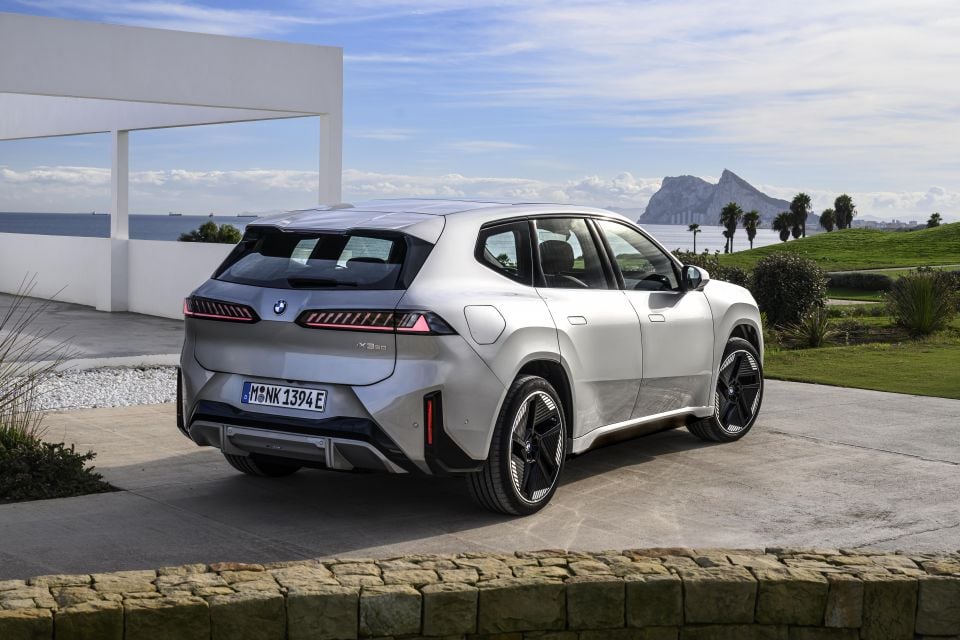
Despite sporting a familiar name, the 2026 iX3 couldn’t be more different to its predecessor. Sure, it’s still a mid-sized electric SUV with five seats and a big boot, but it’s also the first of BMW’s ‘Neue Klasse’ or ‘new class’ series, a fresh generation of vehicles that embody significant changes in technology, design, and production processes.
The shift in design language is most visible, but it’s something of a footnote compared to the technological advancements buried beneath the iX3’s edgy bodywork.
Because at its heart is BMW’s sixth-generation eDrive technology, which combines efficient motors, new high-voltage batteries with cylindrical cells, and 800V underpinnings. The payoff is a driving range of up to no less than 805km and peak DC fast-charging of 400kW for the iX3 50 xDrive launch variant – figures that render even the most worthy rivals a little inadequate.
Performance isn’t lacking, either. The dual-motor 50 xDrive packs 345kW of power and 645Nm of torque, despite not wearing any ‘M’ badges.

Inside, the new iX3 is screen-heavy, button-light and loaded with sustainable materials that challenge traditional definitions of luxury. It also debuts BMW’s innovative ‘Panoramic Vision’, a stretched instrument display that screams showroom appeal.
Behind the scenes, a total of four computers dubbed ‘superbrains’ take care of driving dynamics and automated driving, as well as the infotainment system and interior functions.
Right-hand drive versions of the iX3 Neue Klasse won’t be available to purchase in Australia until the midway point of next year, but that didn’t stop us from heading to Sotogrande, Spain for the international launch of BMW’s most important model in years.
So, is the second-generation iX3 really a game-changing EV? Or does the metal fail to match the marketing? Dig deeper to find out.
How much does the BMW iX3 cost?
We’re not sure yet, although hints can be found in the pricing of both competitors and BMW’s other electric SUVs.
The iX3 50 xDrive represents the launch offering and will be the first iX3 variant offered in Australia, with further variants to follow from 2027 onwards.
Taking into account the dual-motor drivetrain and likely specification of the 50 xDrive, direct rivals include the Audi Q6 e-tron quattro, Porsche Macan 4, Polestar 3 Long Range Dual Motor, Cadillac Lyriq, and Genesis Electrified GV70, all of which are priced between $120,000-140,000 before on-road costs. Of course, we can’t forget Mercedes-Benz and its upcoming GLC with EQ Technology, although we don’t know how much that will cost either.
So, where will the iX3 fall amongst its peers? Well, we’re inclined to think that it may be the cheapest of the bunch.
The previous iX3 topped out at $104,900 plus on-roads, although that was a single-motor model built in China on an established platform. Meanwhile, the larger iX is currently available from $142,900 excluding on-road costs, so it would make sense if the new, dual-motor iX3 fell between those two markers. As such, a starting price of around $120,000 is on the cards.
To see how the BMW iX3 lines up against the competition, check out our comparison tool
Let us help you find your new car
Buy your new car without the stress. It’s fast, simple and completely free.
Great service from Travis and team, second time I have used this business would not hesitate to recommend them to anyone
Craig C.
Purchased a Ford Ranger in Sunshine Coast, QLD
CarExpert helped Craig save thousands on his Ford Ranger, now let us save you on your next new car.
What is the BMW iX3 like on the inside?
Funnily enough, the new iX3 is unlike any BMW that has come before it.
The infotainment interface and trim materials will be somewhat familiar to brand loyalists, but the cabin layout is a radical departure from what we’ve come to expect.
Gone are the physical buttons and switches of yesteryear, most of which have been axed to free up space and enhance aesthetics.
Instead, common vehicle functions including the climate controls are now embedded within a large centre display that’s forced to do a lot of heavy lifting, and it shows.
Because, while the quirky parallelogram screen features fresh BMW Operating System X software, we found it to be laggy and slow to respond at times. It’s not like we were asking for much with our inputs, either.
However, there’s no knocking the resolution of the graphics, nor the vibrancy of the colours. And, more importantly, the screen is housed nice and close to the driver, so it’s easy to reach on the move.
Ease of access doesn’t necessarily translate to ease of use, though. We didn’t spend enough time with the iX3 to come up with concrete conclusions regarding the functionality of the infotainment screen, but it’s clear there’s a steep learning curve attached.
You need only navigate to the vehicle settings menu to realise that the system is endlessly layered, and key features aren’t necessarily housed where you expect them to be. Take the direction of the air vents, for example, which can only be adjusted through the climate control menu. Drive mode adjustments are also reliant on use of the screen.
However, on the other side of the equation, a handful of handy shortcut icons can permanently be found at the base of the screen, and most of the infotainment apps are clearly labelled. And, thankfully, the side mirror controls are still physical buttons located near the window switches, as is tradition.
In addition to modern essentials such as native satellite navigation, wireless smartphone mirroring and connected services, the iX3 offers apps including Spotify, Disney+, YouTube, Zoom and Amazon through its store, as well as games and gaming controller compatibility.
The new software architecture in Neue Klasse models enables more frequent over-the-air updates, so the iX3 won’t miss out on new features that BMW decides to roll out in the future.
That same software and the integration of AI also contributes to the sense that the iX3 is a conscious, clever vehicle – the interior lights automatically switch on when the driver reaches for an object on the passenger seat, and the charging flap opens when you arrive at a charging station, as if by magic.
Innovative tech is a clearly key cornerstone of the Neue Klasse revolution, and that’s even more evident in the inclusion of a new Panoramic Vision display at the base of the windscreen. The pillar-to-pillar projection is essentially a stretched instrument display that shows key driving information including speed, trip data, and navigation directions.
There’s plenty of scope for customisation – the lazy among us can pick from three default layouts, while each of the six individual display widgets can be configured to create something more personal. Speaking of widgets, there’s a total of 16 to choose from including aforementioned basics as well as weather, date, connectivity, charging, and geographic information.
Now don’t get me wrong, the high-resolution screen-like display is impressive to behold. However, I didn’t find that it particularly enhanced the driving experience aside from keeping my eyes angled up towards the road… but isn’t that what the head-up display was invented for? And what’s more, a 3D head-up display is among the list of cost options.
Our test vehicles were also equipped with a banging (but unfortunately not standard) Harman Kardon sound system, while mobile device charging is taken care of by a vertical wireless pad and two USB-C outlets positioned at the base of the infotainment screen.
In front of the driver sits a squircle shaped steering wheel with glassy haptic buttons. Buyers can choose between three different wheel designs that range from unique to downright weird, ie. vertical spokes as pictured throughout this review.
We’ve previously been critical of BMW for producing steering wheels that are too thick to hold comfortably, and this complaint persists, but now you can add jarring design and finicky controls to our list of misgivings. It’s just the price of ‘progress’, I guess.
At least the haptic buttons provide feedback that you can feel through your thumbs, and the M Sport wheel is far less outlandish to look at. Depending on specification, the wheel is trimmed in either Veganza faux-leather or genuine Merino leather, both of which pass the touch test.
The seats likewise pass this test, and also meet comfort expectations. As standard, the xDrive 50 comes with vegan leather seats that feature electric adjustment, three-stage heating, and a massage function with seven different modes for the driver.
There’s ample cushioning and lateral support, too, with even more on offer if you upgrade to the beefed up M Sport seats, which also gain thigh extensions. Neither offer ventilation though, and there’s nowhere soft to rest your left knee during long stints behind the wheel.
Further, not all the materials found throughout the iX3 back up its positioning as a luxurious mid-sized SUV.
On the plus side, BMW has ridded the cabin of the glossy black plastic that Audi and Mercedes-Benz still worship – a huge win for owners could like to keep their car clean for more than a day or two. However, the top sections of the dash and door cards aren’t as soft as you might expect, while the headlining feels a little cheap.
Similarly, the woven fabric trim found on the front of the dash has seemingly been plucked straight of a Mini, although BMW assured me that’s not the case.
So, while it’s commendable that BMW has placed a huge amount of emphasis on sustainability for its Neue Klasse era, that shouldn’t come at the cost of premium feel.
Opting for one of the two M Sport packages remedies this somewhat by introducing suede to the materials mix, as well as thoughtful touches like tri-colour M stitching on the seatbelts. And, materials aside, build quality feels rock solid.
A lack of cabin storage also lets the new iX3 down, limiting its everyday practicality. The door bins are oddly shaped and won’t accommodate a large drink bottle, while the glovebox and centre console likewise lack acreage. There’s no cubby for your sunglasses, either.
Given the premium positioning of the iX3, I was also disappointed to find that neither the door bins nor centre console are lined with either felt or rubber, which serves to reduce the annoying rattling of loose items. This is especially surprising considering the storage tray under the central bridge has a rubberised floor.
Space is less of an issue in the second row. Well, when it comes to seating passengers, anyway.
For starters, the doors open wide, so it’s easy to get in and out. And though my driving position is set quite far back, I was still able to slide in behind without issue. Headroom is even more plentiful, and our tester was equipped with a tinted glass roof that lightens up the cabin without turning the iX3 into a luxurious oven.
A completely flat floor also encourages use of the middle seat, despite its firmer base and backrest.
Aside from plush seating, the second row is a little bare bones for the price. Amenities include two USB-C outlets, a pair of air vents, and a fold-down armrest with substantial cupholders, but there’s no seat heating. Map pockets are missing, so you’ll need to find somewhere else to store books, magazines and other small items.
At the rear of the iX3 you’ll find a relatively conventional boot area with 520 litres of space – slightly more than the outgoing iX3 but less than an Audi Q6 e-tron or the related Porsche Macan. A power tailgate is standard, and a flat loading bay makes loading bulky items a breeze. An additional 58L of cargo capacity is available in the form of a ‘frunk’.
Don’t expect to find a spare wheel though, as there is none. I found this out the hard way after popping a tyre at the top of a mountain pass, which resulted in a lengthy wait for assistance. The view was spectacular, though.
| Dimensions | BMW iX3 |
|---|---|
| Length | 4782mm |
| Width | 1895mm |
| Height | 1635mm |
| Wheelbase | 2897mm |
| Cargo capacity | 520L (behind rear seats) 1750L (behind front seats) |
To see how the BMW iX3 lines up against the competition, check out our comparison tool
What’s under the bonnet?
The sixth-generation BMW eDrive technology developed for the Neue Klasse comprises highly efficient electric motors, new high-voltage batteries with cylindrical cells, and an 800-volt electrical architecture.
| Specifications | BMW iX3 50 xDrive |
|---|---|
| Drivetrain | Dual-motor electric |
| Battery | 108kWh NMC lithium-ion |
| Power | 345kW |
| Torque | 645Nm |
| Drive type | All-wheel drive |
| Weight | 2360kg |
| 0-100km/h (claimed) | 4.9s |
| Energy consumption (claimed) | 15.1-17.9kWh/100km |
| Energy consumption (as tested) | 17.3kWh/100km |
| Claimed range | 805km |
| Max AC charge rate | 11kW |
| Max DC charge rate | 400kW |
Power and torque sit at 345kW and 645Nm respectively, giving the iX3 a serious performance advantage over many of its rivals.
It also boasts the longest driving range of any EV currently sold in Australia – 805km, to be exact. In other words, owners are unlikely to ever experience ‘range anxiety’.
BMW has also taken some of the stress out of public charging by boosting the iX3’s maximum charging rate to 400kW, which enables owners to add more than 350km of range in just 10 minutes. But it’s worth noting that you’re unlikely to ever see charging speeds in this ballpark when using Australia’s public DC fast-charging network, at least for now.
To see how the BMW iX3 lines up against the competition, check out our comparison tool
How does the BMW iX3 drive?
Electric SUVs have seldom been this satisfying to steer.
Trusted Reviews, Smarter Choices, Better Prices
Where expert car reviews meet expert car buying – CarExpert gives you trusted advice, personalised service and real savings on your next new car.
We experienced the 50 xDrive in a variety of scenarios from suburban driving to highway cruising and even a brief stint on a racetrack.
Put simply, it excelled in each environment, thanks in no small part to a next-level drivetrain and balanced chassis tuning.
At low speeds, the iX3 exhibits all the hallmarks of an accomplished EV. It’s quiet, smooth and predictable, with a progressive right pedal that makes urban driving a simple task. The brake pedal is firm but not quite as user-friendly, although BMW says 98 per cent of braking can be done using recuperation only, i.e. without application of the friction brakes.
And it’s worth utilising the regenerative braking capabilities of the iX3, as the system is well-judged and configurable. A low regen setting is available for those who want more control over braking, while ‘B’ mode makes for proper single-pedal driving.
Speeding up is just as straightforward as slowing down. The 50 xDrive sends 345kW and 645Nm to all four wheels – a recipe for fun in just about any driving scenario.
With that said, many modern EVs struggle to put their power down, whether that’s due to cheap tyres, excessive weight, or electronic limitations. But not this one.
Rather, the iX3 takes off cleanly from a standstill. The Goodyear Eagle F1 tyres hook up immediately, and before long you’re travelling at highway speeds.
Hard acceleration is accompanied by synthesised spaceship sounds that will likely prove divisive, although the soundtrack here is more palatable than most. And regardless of how it sounds, the iX3 is quick enough to put a smile on your face.
It’s also capable of covering huge distances between charging stops. BMW’s claim is 805km and that seems achievable in the real world – our hilly, high-speed driving stint reduced the range to 650km-ish, but that’s just about a worst-case outcome.
To put that into context, the Polestar 3 Long Range can eke out a claimed 706km on a full battery, while the Q6 e-tron quattro can travel just 542km. As such, the new iX3 really is a game-changer.
But BMW buyers typically expect more than straight-line pace and efficiency. They expect ‘the ultimate driving machine’. So, how does the iX3 Neue Klasse fare in that department? Surprisingly well, for a 2.4-tonne SUV.
Considering its dimensions, the iX3 is quick to change direction and benefits from a variable-ratio steering system that loads up as you turn the wheel, providing excellent feedback to the driver.
The rear-biased nature of the all-wheel drive system also gives the 50 xDrive a playful character that’s quintessentially BMW. Purposeful driving sees the back end rotate around corners in a controlled manner, and things get a little squirrelly if you mash the throttle when exiting a corner.
All the while, an advanced traction control system prevents any nasty surprises. And when driven sensibly, the iX3 demonstrates excellent body control and stability when cornering despite its immense heft.
I doubt many Australian owners will punt their iX3 through the mountains as we did during the launch event, but it’s always reassuring to know that a vehicle has been developed with the act of driving in mind.
This focus on driving pleasure gives the iX3 an advantage of rivals such as the Genesis Electrified GV70 and Cadillac Lyriq, both of which offer similar performance but none of the fizz.
The iX3 isn’t alone in this regard, as the Audi Q6 e-tron is also a decent drive. However, BMW has managed to engage the steerer without compromising on comfort.
To caveat this, the Spanish roads we experienced were mostly unblemished, and certainly smoother than those in Australia. Nevertheless, there’s enough evidence to suggest that the first Neue Klasse SUV will be pleasant to live with day-to-day.
While not soft, we found the ride to be compliant and free of the harshness that plagues alternatives such as the aforementioned Audi. The few nasty sections of tarmac we came across induced bobbling but nothing harsher, and that’s on standard passive suspension. Adaptive dampers will further boost comfort when they eventually arrive with new iX3 variants.
That impressive ride quality carries over to high-speed highway driving – an environment in which the iX3 thrives.
Because beyond smoothness, BMW’s first Neue Klasse model boasts low levels of vibration and road noise, as well as some of the best calibrated driver assist systems (ADAS) on the market.
One of the iX3’s four ‘superbrain’ computers is solely dedicated to ADAS, and that’s apparent in both the competence and agreeableness of the systems.
Many new cars suffer from hyper-sensitive safety assists that beep and flash at every opportunity, but the iX3 is more measured in its delivery of warnings. Sure, the speed sign recognition system sometimes struggles to cope with roadworks signs and the like, but other aids such as the attention monitor and lane-keep assist aren’t intrusive.
And if for some reason you do become fed up with a particular feature, BMW has made it much easier to dumb down certain warnings. For example, there’s now a ‘reduce warnings’ icon in the vehicle settings which loosens several parameters in a single tap, while divisive helpers such as the overspeed warning can be switched off completely using touch-sensitive buttons next to the infotainment screen.
More impressive than that is BMW’s autonomous driving technology.
As part of the iX3 launch we were introduced to the brand’s new ‘Assisted Driving Pro’ function – a hands-off adaptive cruise control system available for use on European highways. While not quite at the level of Tesla’s full self-driving (FSD) system, Assisted Driving Pro inspires enough confidence to be left to its own devices during long-distance touring, and BMW says this is just the beginning. It’s just a shame that this tech won’t be available in Australia for the foreseeable future.
Having said that, local buyers will have access to Assisted Driving Classic, a nearly-as-capable alternative. In addition to combining adaptive cruise control and active lane centring, this lets you lean on the brakes without cancelling the cruise setting, an evolution I warmly embrace.
The ADAS computer also houses automated parking functions, including remote parking through the My BMW app.
To see how the BMW iX3 lines up against the competition, check out our comparison tool
What do you get?
The iX3 will launch in a single trim grade – 50 xDrive, although buyers can also opt for one of two M Sport option packs to spice things up.
2026 BMW iX3 50 xDrive equipment highlights:
- 20-inch alloy wheels
- LED headlights
- Power tailgate
- Veganza leather upholstery
- 43.3-inch BMW Panoramic Vision display
- 17.9-inch touchscreen infotainment system
- Wireless Apple CarPlay and Android Auto
- BMW Intelligent Personal Assistant
- BMW ConnectedDrive app store
- Satellite navigation
- 3D head-up display
- Multi-colour ambient lighting
- Dual-zone climate control
- Wireless charging pad
- Power-adjustable front seats
- Heated front seats
- Over-the-air updates
- Digital key
Nine paintwork finishes will be available from the start of production for Australia, including the new Polarised Grey metallic and Ocean Wave Blue metallic.
Electric folding side mirrors are now standard across the iX3 range. This addition will barely register with most buyers, but it’s an important inclusion for those who regularly park their car on the street.
To see how the BMW iX3 lines up against the competition, check out our comparison tool
Is the BMW iX3 safe?
The new iX3 does not yet have a safety rating from ANCAP or Euro NCAP, but it packs plenty of modern safety equipment including a ‘hands-off’ cruise control system that’s been approved for European markets.
Standard safety features include:
- 9 airbags
- ‘Symbiotic driver assistance’
- Adaptive cruise control
- Collaborative steering
- Collaborative brakes
- Speed limit warning
- Front collision warning
- Lane departure warning
- Lane change warning
- Road priority warning
- Safe exit warning
- Assisted view
- Automated parking
To see how the BMW iX3 lines up against the competition, check out our comparison tool
How much does the BMW iX3 cost to run?
All BMW models are covered by a five-year, unlimited-kilometre warranty in Australia. The battery is also covered for eight years or 160,000km – whichever comes first.
BMW hasn’t released servicing information for the iX3 just yet, although the brand has confirmed the new model will remain subject to a condition-based servicing schedule. For context, a basic six-year service package for the previous-generation iX3 cost $2325.
BMW has historically thrown in a complimentary Chargefox subscription with the purchase of a new iX3, but it’s unclear what incentives will be offered this time around.
Owners can also extract more value out of their iX3 by taking advantage of its bidirectional charging functions including vehicle-to-load (V2L), vehicle-to-home (V2H), and vehicle-to-grid (V2G). The former is planned for the Australian market, promising the ability to draw power from the car’s battery to use everyday appliances, power tools, and camping equipment.
To see how the BMW iX3 lines up against the competition, check out our comparison tool
CarExpert’s Take on the BMW iX3
There’s a lot to like about the new iX3 and the tone it sets for future BMW models.
In 50 xDrive guise, the iX3 raises the bar for the combination of efficiency and performance that can be extracted from an electric powertrain.
Not only can this family SUV consistently cover 800km between charging sessions, but it’ll do so while providing straight-line performance to rival most sports cars.
And despite weighing in at nearly 2.4 tonnes, the iX3 remains faithful to BMW’s promise of ‘the ultimate driving machine’, as we found out on some of Spain’s twistiest roads.
That said, many new car buyers aren’t all that interested in driving. BMW understands that, as evidenced by the impressive capability of the iX3’s upgraded assist systems. European customers will benefit from this most, but Australian buyers can still expect excellent levels of semi-autonomy.
Our first experience of a Neue Klasse interior conjured up mixed feelings. The tech is flashy and there’s room for a family to travel in comfort, but the infotainment system demands a steep learning curve. Storage space is a little lacking, too.
Best to withhold judgement until we’ve spent some more time with the iX3, then.
Speaking of withholding judgement, other key unknowns stand in the way of a decisive conclusion. For one, we don’t yet know what the 50 xDrive will cost in Australia. Question marks also remain over standard specification.
But, on balance, we remain quietly confident that the iX3 will shoot to the top of the premium electric SUV hierarchy when it arrives Down Under in mid-2026.
CarExpert can save you thousands on a new BMW iX3. Click here to get a great deal
Click the images for the full gallery